Disclosure: This is an independent guide. Some links below are affiliate links, which means we may earn a small commission if you buy through them, at no extra cost to you. It never changes our recommendations.
The single most confusing thing about SHEIN Curve is the label on the first size. A 0XL is not a 16. It is closer to a 12. Everything downstream of that misunderstanding — the returns, the “why is this enormous” reviews, the assumption that plus sizing on SHEIN is broken — follows from people reading the letter instead of the chart.
Once you know that, the range becomes considerably easier to buy from than the main line.
Quick answer: SHEIN Curve is the plus-size range, cut for curvier proportions rather than scaled up from a sample size, at the same prices as the main line. The sizing labels sit roughly two sizes below what most shoppers expect: 0XL lands around a US 12, and the range runs to about a US 22–24 depending on the section. Curve is generally more consistent than standard SHEIN, but it is still supplier-dependent, so the per-item measurement chart — not the letter — is the only reliable guide.
Curve is a different cut, not a bigger cut
This is the part worth knowing, because it decides whether you should shop Curve or just size up in the main range.
Standard sizing on most fast-fashion sites is graded: a pattern is drawn for a sample size and then scaled outwards, which adds length and width uniformly and produces plus-size garments that gape at the waist and strain across the hip. Curve items are drafted with different proportions — more room through hip and bust relative to waist, longer rise on trousers, deeper armholes.
The practical consequence: if your measurements sit near the top of the standard range, a Curve item in an equivalent size will usually fit better than the standard item in its largest size, even though the numbers look similar. The main range’s XL is an XL that has been stretched. Curve’s 0XL was drawn as a 0XL.
The numbers, and why the labels mislead
SHEIN Curve labelling starts at 0XL and runs up through 1XL, 2XL, 3XL and beyond, with the top of the range varying by section and market — some parts of the site go to 4X, others to 5XL.
The rough translation that catches everyone out:
- 0XL sits around a US 12, not the 16 the label implies
- 1XL is roughly a US 14–16
- 2XL is roughly a US 16–18
- 3XL is roughly a US 18–20
- The top of the range lands around a US 22–24
Treat that as orientation, not gospel. It is a reasonable starting point for narrowing down which two sizes to compare, and it is not a substitute for the chart on the listing you are actually looking at.
How to use the measurement chart properly
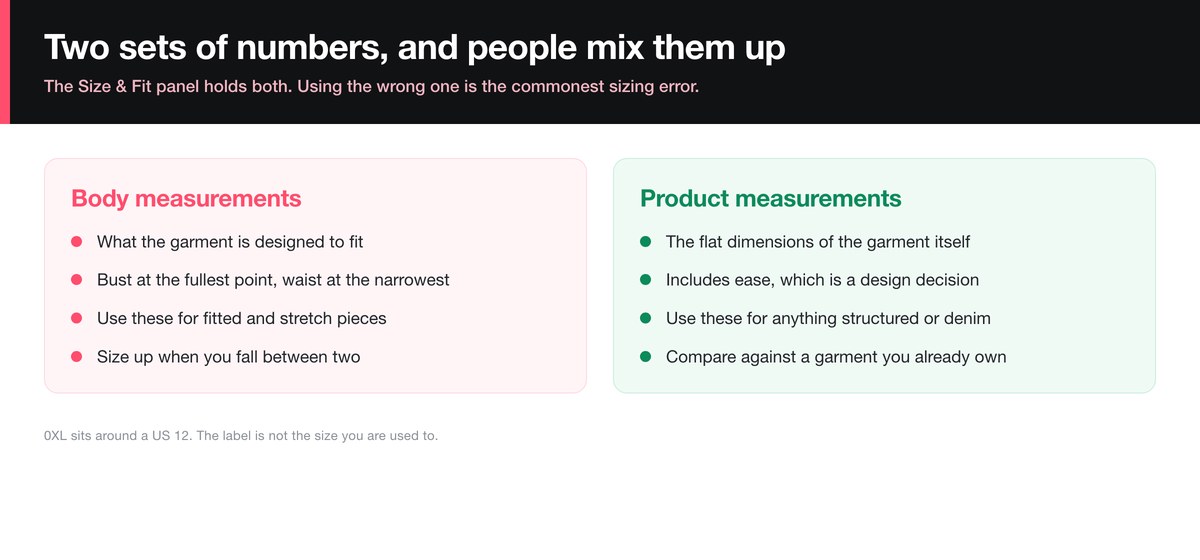
Every SHEIN listing carries a Size & Fit panel with two different kinds of numbers, and mixing them up is the most common self-inflicted sizing error on the site.
Body measurements are what the garment is designed to fit — your bust, waist and hip. Product measurements are the dimensions of the flat garment itself: shoulder, bust across, length, sleeve. They vary item to item because they include ease, and ease is a design decision.
The method that works:
- Measure yourself once, properly. Bust at the fullest point, waist at the narrowest, hips at the widest, tape level and snug but not pulled tight. Write the three numbers down where you can find them.
- For fitted items, work from the body measurement column and size up if you are between sizes.
- For anything structured — a blazer, a shirt dress, denim — ignore the body column and compare the product measurements against a garment you already own that fits the way you want. This is the single highest-value habit in this article.
- Check the fabric composition. A dress with elastane in it forgives two centimetres. A rigid woven does not.
SHEIN also offers a fit-finder tool that suggests a size from your details. It is a reasonable tiebreaker and a poor primary source, because it cannot see the ease built into an individual pattern.
What Curve does well, and where it still falls down
Works well: jersey dresses, knitwear, wide-leg trousers, swimwear and anything with stretch. These are forgiving cuts where a centimetre of variance disappears into the fabric, and Curve’s proportions genuinely help.
Mixed: denim. When it is right it is very good value; when it is wrong it is wrong at the waist-to-hip ratio, which no amount of sizing up fixes. Read the reviews for the word “gaping”.
Weak: structured tailoring, exactly as in the main range. A blazer needs fabric weight to hold a shoulder, and at these prices the fabric weight usually is not there. Our quality guide goes through which categories survive.
One consistent complaint worth flagging: sleeve and armhole width. Plus-size drafting frequently adds width through the body without adding it through the upper arm, and several Curve lines inherit that. If you know this is a problem area for you, the product measurement for sleeve width is the one to check before anything else.
Returns are the safety net, so use them cheaply
Given the variance, ordering two sizes of an item you want is a reasonable strategy — provided you do it in one order.
The first return from an order is free and can hold multiple items. Further returns from that same order carry a fee deducted from the refund. So one order with both sizes in it costs nothing to correct; two separate orders placed a day apart cost you a return fee for no reason. This is also why it is worth trying the whole haul on in one session rather than as parcels trickle in. The full mechanics are in our returns guide.
The one category where this does not apply: swimwear and anything hygiene-sensitive is frequently non-returnable. Measure twice.
Price parity, which is not nothing
Worth saying plainly because it is unusual in this market: SHEIN does not charge a plus-size premium. Curve pricing sits in line with the standard range, where a number of high-street brands still charge more for extended sizing or restrict it to online-only in a narrower selection.
That, more than anything on the design side, explains why the range has the customer base it has.
Frequently asked questions
What size is 0XL in SHEIN Curve?
Roughly a US 12, not the US 16 that the label suggests to most shoppers. The Curve range starts lower than the plus-size sizing people are used to, which is why so many first orders come back too large. Confirm against the measurement chart on the individual listing.
Does SHEIN Curve run small?
Curve runs closer to true-to-measurement than the main SHEIN range, but SHEIN sizing overall still runs small against US standards, so sizing up is a sensible default if you are between sizes. Because different suppliers produce different listings, consistency is per item rather than across the range.
What is the difference between SHEIN and SHEIN Curve?
Curve garments are drafted for curvier proportions — more room through bust and hip relative to waist, longer rises, deeper armholes — rather than being the standard pattern scaled up. If your measurements sit near the top of the standard range, the equivalent Curve size usually fits better than the largest standard size.
What sizes does SHEIN Curve go up to?
The top of the range varies by section and market, with parts of the site going to 4X and others to 5XL, which lands around a US 22 to 24. The available sizes are listed on each product page, and stock at the ends of the range moves quickly.
How do I order the right size on SHEIN Curve?
Measure bust, waist and hips once and keep the numbers handy. For fitted pieces, work from the body measurement column and size up when between sizes. For structured items, compare the product measurements against a garment you already own. Order two sizes in a single order so the free first return covers the one that does not fit.
The short version
Ignore the letter on the label and read the chart. Measure yourself once and keep the numbers on your phone. Compare product measurements to a garment you already own for anything structured. Buy two sizes in one order, not two orders. And lean into the stretch categories, where Curve is genuinely good and the price is the same as everyone else’s straight sizing.
More in this series: standard sizing, quality by category, returns and refunds, and saving money.
Sources: SHEIN Curve listings, size guide and Size & Fit panels, plus the SHEIN US return policy, checked September 2026; published plus-size fit reviews and size-chart comparisons. Size labelling, range limits and per-item measurements differ between suppliers, sections and markets, and change without notice. The chart on the listing you are buying is the authority.