Disclosure: This is an independent guide. Some links below are affiliate links, which means we may earn a small commission if you buy through them, at no extra cost to you. It never changes our recommendations.
“Is SHEIN good quality” is the wrong question, and it is why most answers to it are useless. A catalogue running into the millions of listings does not have a quality level. It has a distribution — and the useful skill is knowing which end of it you are standing in.
What follows is the version of this that survives contact with a washing machine.
Quick answer: SHEIN quality tracks fibre content and construction complexity, not price. Knitwear, swimwear, activewear, denim and simple jersey basics hold up reasonably well. Structured tailoring, anything with visible hardware, shoes and bags are where the money disappears. Filter by composition rather than by price, read the customer photos instead of the studio shots, and treat anything under about $8 as disposable by design.
Why price tells you almost nothing
The instinct is to assume the $22 blazer is better made than the $11 one. On SHEIN that correlation is weak enough to be actively misleading, because price is set by the supplier against demand, not against cost of construction. A $12 top in 100% cotton will outlast a $16 one in 100% polyester nearly every time, even though the polyester one photographs better under studio lights.
Fibre content is the single best predictor available to you, and it is published on every listing. Most shoppers never open it.
Read the composition, not the material tag
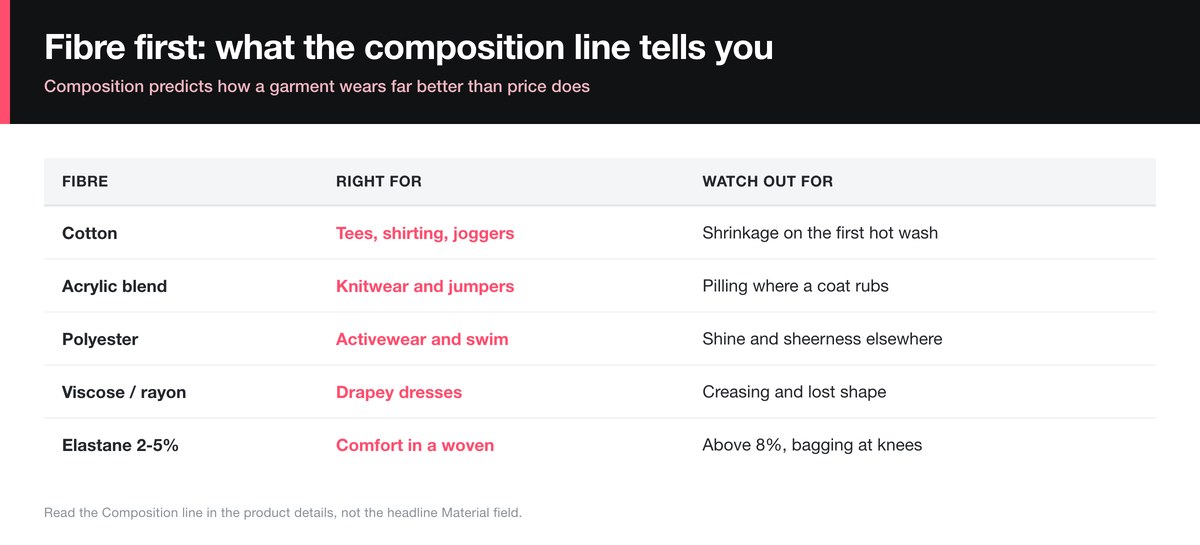
There are two things on a SHEIN listing that look like the same information. The headline “Material” field is marketing — it will happily say “linen look” or “silky”. The “Composition” line inside the product detail panel is the one with percentages, and it is the one to read.
A few rules that hold up across the catalogue:
- Natural fibres exist on SHEIN but are the exception. Cotton mostly turns up in plain tees, shirting and joggers, often blended down with polyester.
- Polyester is not automatically bad. In activewear and swim it is the correct fibre, and SHEIN’s leggings are among the genuinely competitive things it sells. In a “silk-look” blouse or a winter coat lining it means shine, static and no breathability.
- Viscose and rayon feel lovely in the hand and lose their shape fastest. Fine for a drapey summer dress you will wear eight times; poor for anything you need to look crisp.
- If the composition line is missing, vague (“poly blend”), or contradicts the description — a “linen” dress with no flax in it — close the tab. That is the cheapest filter you have.
What holds up
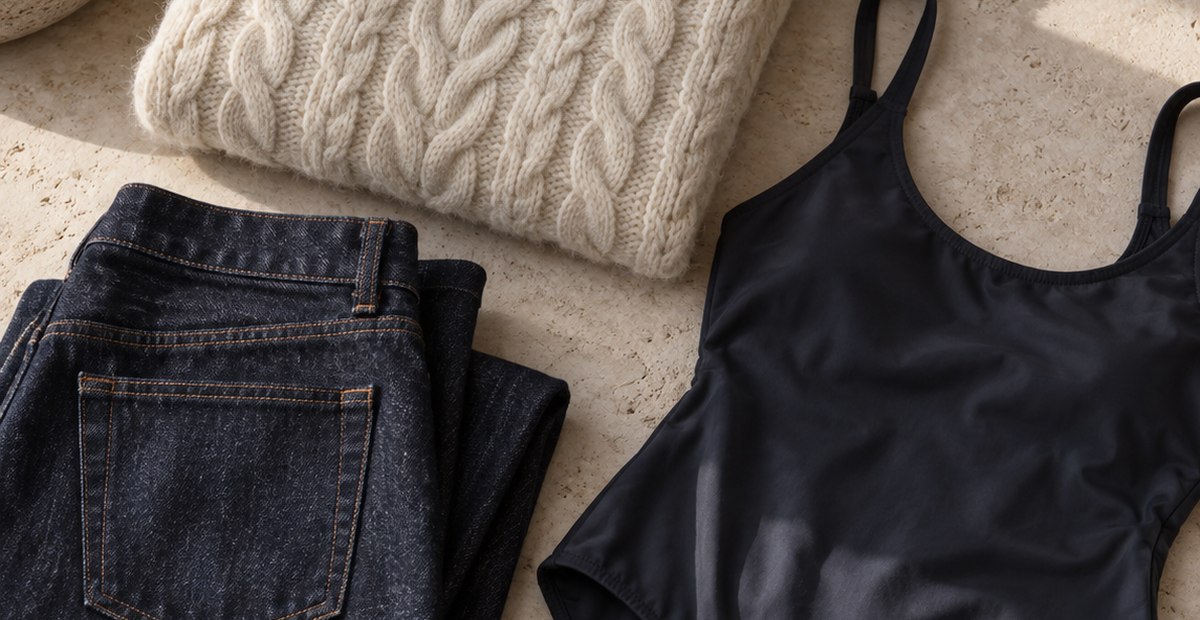
Knitwear is SHEIN’s quiet strength. Chunky knits hide construction shortcuts, and acrylic-cotton blends at a sensible gauge wear far better than their price suggests. Check the review photos for pilling complaints after a few washes.
Swimwear surprises people. It is high-stretch synthetic by definition, which is the one place SHEIN’s default fabric is the right choice. Long-term shoppers report pieces lasting several seasons; the failure mode is fit rather than fabric, so read the measurements carefully.
Activewear. Leggings and sports tops compete directly with brands charging four times as much. The compression is real, the seams are usually flatlocked, and the squat test is the only thing you need to check in the reviews.
Denim. Inconsistent but capable of being very good. Look for listings with hundreds of customer photos and read for the word “stiff” — rigid denim on SHEIN generally means the fabric has body rather than being a jegging in disguise.
Simple jersey basics and layering pieces. Tank tops, plain long sleeves, base layers. Nothing to go wrong, replaced often anyway.
What to skip
Shoes. The most consistently disappointing category on the site. The uppers look right in photographs and the footbed is the problem — thin, unsupportive, and unpleasant after an hour.
Bags. Faux leather with visible edge coating, hardware that dulls, straps attached with stitching that was never load-tested. A bag is a hardware product pretending to be a fashion product.
Structured tailoring. A blazer needs fabric weight to hold a shoulder. Below roughly 220 gsm, expect the collar to roll and the shoulder line to slump within a couple of weeks of wear, whatever the studio photo shows. A jumper is a much safer bet than a jacket.
Anything with a collar, placket or visible zip. Low-cost construction shows up first in buttons, zips and topstitching. A tee is a safer purchase than a button-down at the same price.
The categories to be careful with, for different reasons
Quality and safety are separate questions, and this is where the second one lives.
Seoul’s municipal government has run repeated rounds of laboratory testing on children’s products bought from cross-border platforms. Across seven rounds covering 93 products, harmful substances were reported in a substantial share — including one pair of children’s shoes with phthalates measured at hundreds of times the permitted level, and formaldehyde found in caps at twice the allowable threshold. Greenpeace testing on apparel samples found a minority exceeding EU chemical limits. A CBC Marketplace investigation in Canada found lead above Health Canada’s threshold in children’s items from several of these platforms.
SHEIN’s position is that it uses third-party testing agencies on a risk-based sampling basis and requires suppliers to meet the product safety laws of the markets it sells into. Both things can be true: a sampling regime catches a lot and misses some, and the failures that get published tend to cluster in the same places.
The practical response is not to boycott a platform. It is to be selective by category: infant and toddler clothing, anything a small child will chew, faux leather accessories worn against skin, and soft PVC. If a parcel arrives with a strong chemical smell, wash it twice before wearing it — and if the smell survives that, send it back.
How to vet a single listing in ninety seconds
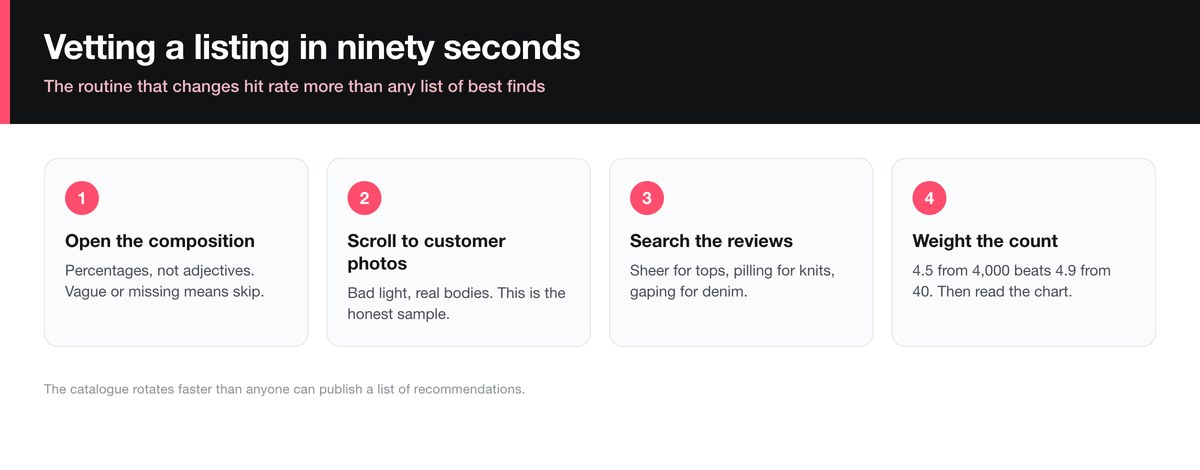
This is the routine that actually changes hit rate:
- Open the composition line. Reject anything vague.
- Scroll past the studio photos to the customer photos. These are shot in bad light on real bodies, which is exactly what you want.
- Search the reviews for the failure word for that category: “sheer” for tops, “pilling” for knits, “scratchy” for anything wool-adjacent, “smell” for anything coated.
- Check the review count, not just the rating. A 4.9 from 40 reviews is noise. A 4.5 from 4,000 is a signal.
- Open the measurement chart for that specific item. SHEIN sizing runs small and varies between suppliers, so a size you own is not a size you can assume.
Two minutes of this beats any list of “best SHEIN finds”, because the catalogue rotates faster than anyone can publish.
Frequently asked questions
Is SHEIN clothing good quality?
It varies enormously by category. Knitwear, swimwear, activewear, denim and simple jersey basics are generally good for the money. Structured tailoring, shoes, bags and anything with substantial hardware are consistently weak. Fibre composition predicts the outcome far better than price does.
How long do SHEIN clothes last?
Items under about $8 are effectively designed for a short trend cycle and often show wear within a handful of washes. Pieces chosen for fibre content — cotton basics, decent-gauge knits, synthetic activewear and swim — routinely last seasons. The variable is what you bought, not the brand.
How do I check the fabric on a SHEIN item?
Open the product details and find the Composition line with the fibre percentages, rather than relying on the headline Material field, which is descriptive marketing. If the percentages are missing or contradict the product description, treat that as a reason to skip the listing.
Are SHEIN clothes safe to wear?
Independent testing has repeatedly found chemical limit breaches in specific categories, particularly children’s products, footwear and coated or faux-leather goods, in results published by Seoul’s city government, Greenpeace and CBC Marketplace. SHEIN says it runs risk-based third-party testing and requires supplier compliance. Being selective by category, and washing new items before wearing, is the sensible middle position.
What should you not buy from SHEIN?
Shoes and bags are the weakest categories by a distance. Structured blazers and coats rarely hold their shape at these fabric weights. Beyond quality, independent testing suggests extra caution with infant and toddler items, faux leather worn against skin, and soft PVC accessories.
The short version
Buy the fibre, not the photograph. Stick to knits, swim, activewear, denim and plain basics. Leave the shoes, the bags and the structured jackets. And accept the deal being offered: at these prices you are buying a garment that looks better than it costs, which is a genuinely good trade as long as you do not expect it to also outlast one.
More in this series: sizing, returns and refunds, saving money, and whether SHEIN is legit.
Sources: Seoul Metropolitan Government product safety testing rounds on cross-border platform purchases, 2024; Greenpeace chemical testing of fast-fashion apparel; CBC Marketplace lab testing of children’s clothing from cross-border retailers; SHEIN product listings and published statements on supplier testing, checked September 2026. Listings rotate constantly; composition and measurements shown on the individual product page are the authority.