Disclosure: This is an independent guide. Some links below are affiliate links, which means we may earn a small commission if you buy through them, at no extra cost to you. It never changes what we recommend.
If you’ve ever lost twenty minutes to a spinning amethyst on JTV, you already know how the channel works. A host tilts the stone under the lights, a counter ticks down, the price drops a little, and suddenly a ring you didn’t want an hour ago feels like a now-or-never decision.
It usually isn’t. Much of what airs sits on jtv.com afterwards, often at the same price or close to it, with a full spec sheet the broadcast never has time to read out. So this guide skips the on-air excitement and goes through the website: what the prices actually mean, what the product listings are really telling you, and the shipping and return rules that decide whether a “deal” stays one.
Quick answer: JTV (Jewelry Television) is a Knoxville, Tennessee jewelry retailer founded in 1993 that broadcasts live 24 hours a day and sells the same stock online at jtv.com. It’s strongest on colored gemstones, loose gems and sterling silver jewelry, and much of the catalog sits between $30 and $200. Ignore the struck-through “was” prices; they’re JTV’s own reference figures and can be ten times the selling price. Standard shipping is $4.99 per item, not per order, unless a free-shipping promotion is running. You get 30 days from receipt to return most things, but $6.99 comes off your refund if you use the prepaid label, shipping isn’t refunded, and anything you’ve had resized can’t go back at all.
What JTV actually is
JTV started life in 1993 as America’s Collectibles Network, a shopping channel broadcasting out of Greeneville, Tennessee that sold whatever it could: baseball cards, knives, electronics, quilts. Jewelry and gemstones outsold everything else, and the company eventually rebranded around them. It’s still headquartered in Knoxville, still owned under the America’s Collectibles Network name, and now runs live programming around the clock from six HD studios, plus the website, mobile apps and streaming channels on Roku and Apple TV.
The part that matters to a buyer is the supply chain. JTV runs sourcing offices in Bangkok, Hong Kong, Jaipur, Mumbai and China, which is why its colored-stone range is so much wider than a mall jeweler’s. On a single page of best sellers you’ll find tanzanite, chrome diopside, aquamarine, garnet, freshwater pearls, lab-grown diamond and moissanite, and the loose-gemstone and jewelry-making sections go further still.
Much of what you’ll see is sold under JTV’s own labels, and learning a few of them saves a lot of squinting at product titles:
- Bella Luce: diamond simulants. Pretty, cheap and not diamond, which is fine as long as you know that going in.
- Moissanite Fire: created moissanite, JTV’s biggest diamond alternative. It comes with a lifetime authenticity warranty for the original buyer.
- Prazana: lab-grown diamonds. Real diamond, grown rather than mined.
- Genusis: cultured freshwater pearls.
- Artisan of Bali, Southwest Style: handcrafted-look silver and turquoise lines.
- Jewel School: beads, findings and tools for people who make their own.
The prices, and what the crossed-out number means
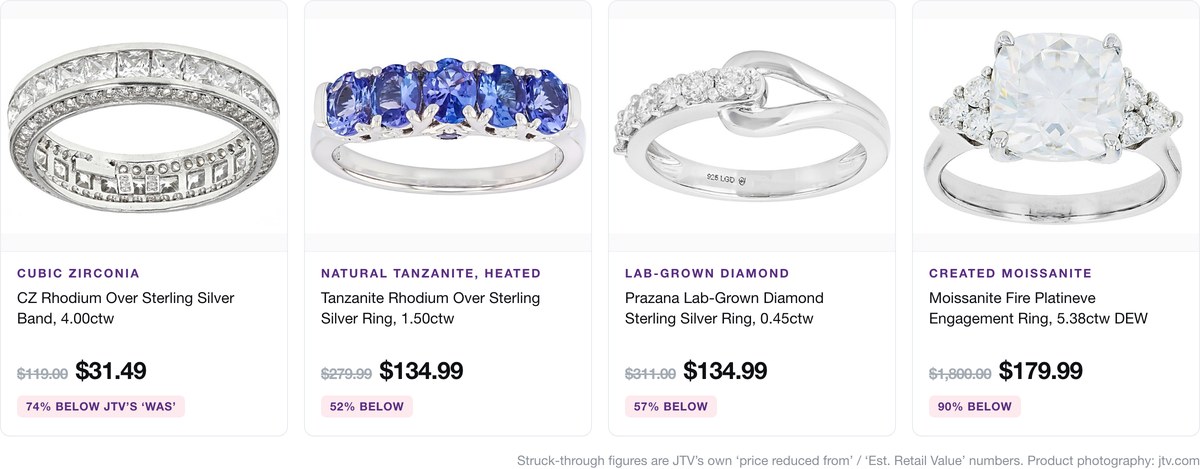
Every JTV listing comes with two prices. One is what you pay. The other is struck through and labelled either “price reduced from” or “Est. Retail Value”, and it’s doing most of the selling.
We pulled four rings from the best-seller list, one for each of the stone types most people are choosing between. The cubic zirconia band was $31.49 against a “was” of $119. The natural tanzanite ring was $134.99, down from $279.99. The lab-grown diamond ring was $134.99 against an estimated retail value of $311. And the moissanite engagement ring was $179.99 against an estimated retail value of $1,800, a 90% “saving”.
That last one is the tell. It’s hard to picture anyone paying $1,800 for that ring. The estimated retail value is JTV’s view of what something comparable might cost elsewhere, and it’s not a price you can check. Treat it the way you’d treat the sticker on a car lot.
The other thing we noticed: the same moissanite ring showed $152.99 on the best-seller grid and $179.99 when we clicked through a few minutes later. JTV reprices constantly (Flash Sale, Power Buy, Super Buy, clearance), and prices follow the broadcast schedule. If a piece you like is sitting at a price that feels high, put it on your Love List and come back. There’s a decent chance it’ll move.
So what’s a fair price? Compare against JTV itself. Search the same stone and a similar carat weight and you’ll usually find a handful of comparable pieces. Under our tanzanite ring alone, JTV suggested other tanzanite rings at $46, $54, $72, $77 and $140. Where your ring sits in that spread tells you far more than any crossed-out number.
Read the spec block, not the title
Here’s where JTV is genuinely better than most jewelry sites: scroll past the marketing copy and every product has a long attribute list covering stone composition, treatment, origin, metal, even the metal weight in grams. It’s dry, and it’s the most useful thing on the page.
It’s also where you catch the problems. The lab-grown diamond ring we looked at is titled “H SI1, 0.45ctw”. The description underneath says “G-H color, VS clarity minimum”. The attribute block lists 0.49ctw, G-H and VS1–VS2. None of that is a scandal, and all three versions are decent for the money, but it tells you the title is a label, not a grading report. Go by the attributes, and if the numbers really matter, call before you buy.
The fields worth reading on every listing:
| Field | What it’s telling you |
|---|---|
| Gemstone Composition | Natural, lab-grown, created or simulated. “Created” means it’s a lab-made version of the same mineral; “simulated” means it just looks like it. |
| Enhancement | “Heated” is standard for tanzanite and many sapphires and isn’t a red flag. “No Treatment” is what you’d hope to see on a lab-grown diamond. |
| ctw vs DEW | DEW (diamond equivalent weight) is used for moissanite and is higher than the stone’s real weight. The 5.38ctw DEW ring we looked at is actually 4.48ctw of moissanite. |
| “Not sizeable” | Usually in the first line of the Product Information. Eternity bands and stone-set shanks can’t be resized, so order your true size. |
| Material | “18K Yellow Gold Over Sterling Silver” is plated silver, not gold. Platineve is JTV’s own white metal name. Solid gold says 10K or 14K with no “over” (and “gold filled” isn’t solid either). |
| Country of Origin | Where the piece was made, which is separate from where the stone was mined. Our tanzanite ring was set in Thailand with stones from Tanzania. |
Shipping: $4.99 sounds small until you add a second item
This is the one that catches people. JTV’s standard shipping is $4.99 per order line item, not per order. Three rings on standard shipping is $14.97, and the expedited options stack the same way:
| Method | Per item | Timing |
|---|---|---|
| Standard | $4.99 | Usually ships in 1–5 business days, then 1–5 days in transit |
| Three-day | $15.99 | Order before 2pm |
| Two-day | $20.99 | Order before 2pm |
| Next day | $35.99 | Order before 2pm; not available on every item |
Canada adds $5 per item and Mexico adds $12 per item, and international buyers pay any duties themselves.
JTV runs free-shipping promotions often enough that it’s worth waiting for one if you’re buying more than one piece. The usual version is free standard shipping on online orders over $99, and it doesn’t apply to JTV Auctions. Check the banner at the top of the site before you check out.
A few other things about delivery that are good to know in advance:
- Items ship separately. JTV sends each piece as soon as it’s packed, so a four-item order can turn up as four envelopes over a week. You’ll get an email for each one.
- Your card is charged when the item ships, not when you order, unless you pay by PayPal or e-check.
- Sizing adds time. Anything that needs resizing or altering can take up to 10 business days to ship.
- Someone has to be home for big orders. Orders from $700 to $3,000 need a signature, and orders over $3,000 go overnight with a signature required.
Returns: 30 days, but read the exceptions
The headline policy is generous: send most items back in the condition they arrived within 30 days of receiving them for a refund or exchange. You can take the refund as Merchandise Credit, which lands in your JTV account within hours, or back to your original payment method, which takes up to 10 business days depending on your bank.
What actually costs you money is in the details:
- $6.99 comes off your refund if you use the prepaid JTV return label, unless the item was flagged for free returns.
- Original shipping, handling and processing fees are never refunded. On a three-item order at $4.99 each, that’s $14.97 you won’t see again.
- Anything sized or altered can’t be returned. If you asked JTV to resize a ring, it’s yours.
- Watches can’t be returned once worn, and Scratch and Dent items are sold as non-returnable (JTV will look at it if the flaw is worse than advertised).
- Send back everything that came with it. JTV won’t accept partial returns, so appraisals and certificates have to go back with the item.
- Miss the 30 days and JTV may still take it, but only for Merchandise Credit and minus a 25% restocking fee.
Two practical notes. Self-service online returns cover items up to $2,999.99; above that you’ll need to call 800-550-8393 for a UPS label. And Merchandise Credit doesn’t expire, but it can’t be spent on JTV Auctions. If you mostly buy from auctions, take your refund to your card.
At holiday time JTV usually extends the window: items bought between October 9 and December 24, 2025 could be returned until January 31, 2026. Worth remembering for this year’s gifts.
StretchPay, and when it’s actually useful
StretchPay is JTV’s in-house installment plan. Eligible items can be split into several payments with no extra charge from JTV. The number of payments depends on the item and is shown next to the StretchPay logo (the tanzanite ring we looked at was seven payments of $19.28). Affirm is offered as well.
It works well if you use a debit card and just want to spread a $150 purchase over a few months. A few catches:
- The first payment (the deposit) is taken on the day the item ships, then one payment every 30 days after that.
- Shipping, sizing and appraisal fees all go into the deposit, so your first payment is bigger than the rest.
- JTV doesn’t charge interest, but if you pay with a credit card and carry a balance, your card issuer will.
- You have to choose StretchPay when you order. It can’t be added afterwards, and prepaid cards and PayPal Credit aren’t accepted.
- If you return a StretchPay item, you’re refunded the payments JTV has collected so far.
You’ll also be offered a 2-year protection plan on most pieces, which was $19.99 to $29.99 on the rings we checked. For a $30 sterling band that’s close to the price of the ring. It makes more sense on a piece you’ll wear every day.
Who JTV suits, and who should shop elsewhere
JTV is at its best for people who love colored gemstones and don’t want to pay jewelry-store prices for them. The range of stones is unusual, the listings tell you what’s been treated and where the stone came from, and sterling silver settings keep prices reachable. Collectors buying loose gemstones and people who make their own jewelry are well served too. There aren’t many places where you can buy a parcel of loose garnets, a bag of findings and a pair of earrings in one order.
It’s a weaker fit if you want solid gold (much of the catalog is gold-plated silver, so filter by metal purity), or if you’re buying a bridal diamond and want independent lab grading on the stone. JTV does sell diamonds and lab-grown diamonds, but for a big engagement purchase you’ll want the certificate first, and the conversation second.
And be honest with yourself about the live broadcast. The countdowns and “12 sold today!” badges are the business model. If you find yourself buying mostly while the channel is on, the 30-day return window is your friend: use it.
How we’d shop JTV
- Browse on the website, not the TV. Same stock, no countdown, and the full spec sheet.
- Filter hard. Gemstone composition, metal purity and price are the three filters that remove most of the noise.
- Ignore the crossed-out price. Compare similar pieces on JTV instead.
- Read “Not sizeable” before you pick a size, and order your true size rather than planning to resize.
- Batch orders around a free-shipping promotion, since shipping is charged per item.
- Keep the packing slip and the box until you’re sure. The prepaid return label is on the invoice.
Frequently asked questions
Is JTV legit?
Yes. JTV has been selling on TV since 1993 and online since the early 2000s. It’s headquartered in Knoxville, Tennessee, operates under America’s Collectibles Network, and is one of the largest non-bridal jewelry e-commerce sites in the US. Its staff includes Graduate Gemologists and Accredited Jewelry Professionals.
Are JTV’s “was” prices real?
They’re JTV’s own reference prices, shown as “price reduced from” or “Est. Retail Value”. They aren’t prices you’ll find the item selling for, and on some pieces they’re around ten times the selling price. Compare similar items on JTV instead.
How much is shipping at JTV?
Standard shipping is $4.99 per item. Three-day is $15.99, two-day is $20.99 and next-day is $35.99, all per item. Free-shipping promotions on online orders over $99 run regularly.
What is JTV’s return policy?
30 days from the date you receive the item, for an exchange or a refund. $6.99 is taken off the refund if you use the prepaid JTV return label, shipping charges aren’t refunded, and resized, altered, worn watches or items sold as non-returnable can’t be sent back.
Is JTV jewelry real gold?
Some of it. Listings marked 10K or 14K gold are solid gold. Anything described as “gold over sterling silver” is gold-plated silver, and “gold filled” is a thick gold layer over a base metal. Check the Material field in the product details.
What does DEW mean on JTV?
Diamond equivalent weight. It’s used for moissanite and describes the size a diamond of the same dimensions would weigh, which is higher than the moissanite’s real carat weight. The real weight is usually listed in the product information.
Does StretchPay charge interest?
JTV doesn’t add any charge for StretchPay. But if you pay the installments with a credit card and carry a balance, your card issuer’s interest applies.
The short version
JTV is a good place to buy colored gemstones and silver jewelry at fair prices, as long as you shop it like a website rather than a TV show. Ignore the crossed-out prices, read the spec block, check whether a ring can be resized before you pick a size, and wait for free shipping if you’re buying more than one thing. Then the 30-day return window covers you for everything else.
More shopping guides: Whatnot, the other live-shopping app and how to judge sale prices online.
Sources: jtv.com shipping policy, returns policy, StretchPay FAQ, About JTV page and Moissanite Fire brand information, plus product detail pages for items CTB1412, LGA897, JMF877 and DOCK050 and the best-sellers listing. Prices, reference prices and payment plans were recorded at the time of writing. JTV reprices often; the figures shown at checkout are the ones that count. Product photography is JTV’s own.