Note: This is an independent guide. We are not affiliated with Decathlon and there are no affiliate links on this page. To write it we pulled 1,799 live listings from decathlon.com.br’s own catalogue in September 2026 and worked from the prices, sellers and product attributes the site publishes. Product photography is Decathlon’s own.
The hard part of shopping at decathlon.com.br is not the price. It is that nothing is called what it is.
You want a two-person tent. Search “barraca” and you get sixty-eight listings, fewer than half of which say how many people fit, because the rest are pegs, guy-line elastic and replacement pole tips filed under the same name. You want running shoes and you are offered Jogflow 100.1, JF190 Grip, Kipcore 500 and KS900 Light, by two different brands that turn out to be the same brand. There are no reviews worth reading. There is no shop assistant.
There is, however, a system, and it is not hidden — it is printed on the side of every box. Once you can read it, the catalogue stops being 1,800 identical grey rectangles and turns into something closer to a menu.
Quick answer: Decathlon’s own brands are the only reason to shop here, and they are numbered. 100 is entry, 500 is mid, 900 is top — across the 1,792 own-brand listings we pulled, the median 100 costs R$84,99, the median 500 costs R$151,99 and the median 900 costs R$249,99. For most people starting a sport, the 100 is genuinely enough and the 500 is the upgrade worth paying for. Ignore the star ratings: 70% of products have none at all, and 97% of the rest are stamped with exactly “4”. Ignore the crossed-out “was” price too — 77% of the catalogue carries one at any given moment, and 80% of those are a flat 5%, 10% or 15% lever rather than a real sale. The one category where it is worth spending past the entry rung is cycling.
The number on the label is the price
Decathlon runs a tiered numbering scheme across almost everything it makes. The names change by sport — MH and NH for hiking, JF and KS for running, ST and EXPL for mountain bikes — but the number after the letters means the same thing everywhere: roughly how much of the product is there.
We tested this against the catalogue rather than taking it on faith. Pulling every own-brand listing whose name contained a tier number and taking the median price of each rung:
| Number | What it is | Median price | Listings |
|---|---|---|---|
| 100 | First one you buy. Does the job, heavier, fewer adjustments. | R$84,99 | 228 |
| 500 | You do this most weeks. Better materials, real fit options. | R$151,99 | 320 |
| 900 | Club level. Lighter, technical, priced against actual brands. | R$249,99 | 80 |
You will also see 300 and 700 occasionally, but only a handful of lines use them, so treat the ladder as three rungs rather than five. The medians roughly double at each step, which is the useful part: if you are looking at a 500 and wondering whether the 900 is worth it, the honest answer is that you are about to pay 65% more for the last 10% of the product.
One tent, four prices
The clearest way to see the system working is to look at a single product that exists at four points on the ladder at once. Quechua’s two-person MH100 is the entry tent. Every version above it is the same tent with one named thing added.
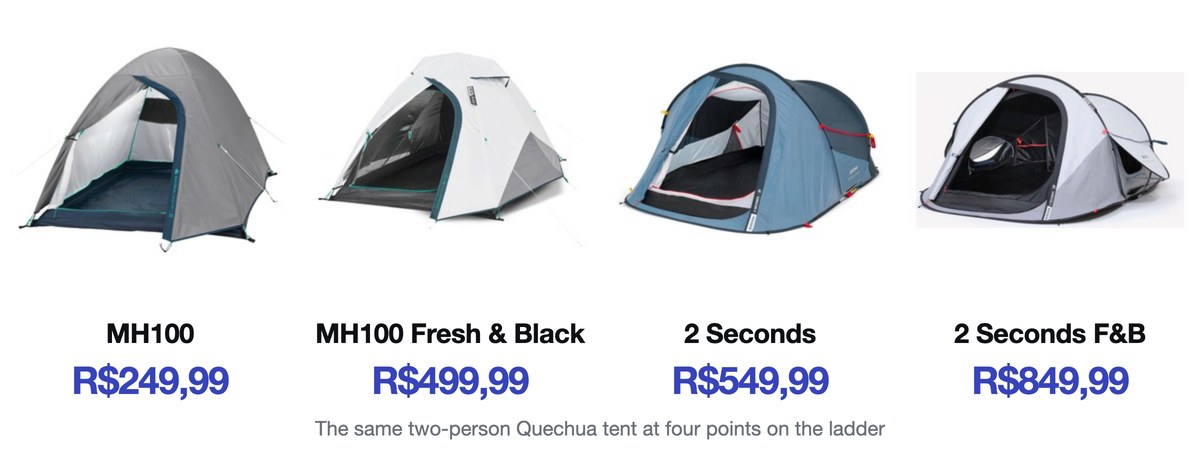
| Tent, 2 people | Price | What the extra money buys |
|---|---|---|
| MH100 | R$249,99 | Nothing. This is the baseline. |
| MH100 Fresh & Black | R$499,99 | Blackout inner. Keeps the sun off you past 6am and runs cooler. |
| 2 Seconds | R$549,99 | Pop-up frame. Pitches in seconds, packs into a disc you cannot fit in a rucksack. |
| 2 Seconds Fresh & Black | R$849,99 | Both of the above. |
Doubling your budget here buys you a darker bedroom, not a better tent. In Brazilian heat the Fresh & Black is a more defensible upgrade than it would be in Europe — a tent that is still bearable at 9am is worth something in Bahia in January. But if you are camping three weekends a year, the R$249,99 one is the right answer and the R$600 you did not spend buys the sleeping bag, the mat and the pack.
Do not shop by the star rating
This is the part that surprised us. Of the 1,792 own-brand listings we pulled, only 534 carry a rating at all — and of those, 518 are stamped with exactly “4”. Fifteen say 5. One says 2.
That is not a review distribution. That is a default value. Whatever the number on the product page is doing, it is not telling you that other customers liked this tent more than that tent, and a rating that is identical across 97% of the products carrying it cannot rank anything. The tier number is the only quality signal the site actually gives you, which is why it is worth the five minutes it takes to learn.
Camping and hiking: the best value on the site
Quechua accounts for 345 of the listings we pulled and Forclaz another 134, which makes hiking and camping comfortably the deepest part of the Brazilian catalogue — and the part where the prices look most like a mistake.
- Mochila de Trilha 10L Arpenaz 50 — R$39,99. A 10-litre daypack for the price of two coffees. It is one main compartment and a mesh pocket, there is no hip belt and no rain cover, and for a day on a trail with water and a sandwich that is the entire specification. Probably the single best-value object on the site.
- Saco de Dormir 20°C Arpenaz — R$89,99. Read the number: 20°C is the comfort limit, not a minimum survival rating. For coastal and central Brazil most of the year it is correct. For the serra in July it is not, and you want the 10°C at R$224,99.
- Barraca MH100 2 Pessoas — R$249,99. Discussed above. Two adults fit; two adults and a bag do not.
- Cutlery and bowls from R$11,69. The Forclaz MT500 folding fork and the MH100 0.45L bowl both come in under twelve reais, which is the kind of price that makes it silly to improvise.
The trap in this category is the search results rather than the products. Searching “barraca” returns pole elastic, peg kits and pole-tip spares before it returns tents, several of them tagged with the same MH100 name. Check that the thing in your basket has a person count in the title.
Running: two brand names, one brand
Decathlon is mid-way through renaming its running line from Kalenji to Kiprun, and Brazil is living through the overlap. Both names are on the site, sometimes on the same shoe. It is not a quality difference and there is no reason to prefer one label over the other — only the model number matters.
- Tênis Jogflow 100.1 — from R$169,99. The entry shoe, sold under both names. If you are running twice a week and none of it is far, this is the one. It is heavier than a proper trainer and the outsole wears quickly on asphalt.
- Tênis Kipcore 500 — R$299,99. The upgrade that is actually worth it: more cushioning, better upper, and the rung where Decathlon stops feeling like a supermarket shoe.
- JF190 Grip — around R$269,99. Trail-biased tread. Only buy it if you actually run on dirt; the lugs are noisy and slow on pavement.
- Camiseta Run 100 Kiprun — R$39,99. Technical tee at fast-fashion money. Buy several.
One warning on the shoes specifically: a few lines carry steep-looking markdowns, and a KS900 Light at R$249,99 from R$499,99 looks like the deal of the page. Note what else is on that shelf — the KS900 2 at R$349,99, the KS900 Support at R$664,99, another KS900 Light at R$399,99. When one colourway of a 900 is half the price of its siblings, you are looking at the end of a line in the sizes nobody took, not at a 900 that has quietly become mid-range. Fine if it fits. Check that your size is actually in stock before you get attached.
Cycling: the one place to spend more
Everywhere else on this site the entry tier is the smart buy. Bikes are the exception, because a cheap bike is not a smaller version of a good bike — it is a heavier one with components that wear out and then cost money to replace.
The Brazilian range starts with the Rockrider EXPL 50 aro 29 at R$1.499,99 and climbs, via the ST 120 at R$1.899,99 and the Explore 100 at R$1.999,99, to a Van Rysel RCR with Shimano 105 Di2 at R$32.999,99. There is a full-suspension carbon Rockrider on the site at R$35.000,00, which tells you the range now runs the whole way up.
For a first adult mountain bike the EXPL 50 at R$1.499,99 is a real bike and the right starting point. The R$500 step up to the Explore 100 is the one we would actually make if the bike is going to be ridden weekly rather than occasionally — on this ladder that rung is where the groupset and brakes stop being the cheapest parts on the frame. Check the component list on the product page before you commit, because Decathlon changes bike specifications between model years more often than it changes the names. Kids’ bikes are a different calculation: Btwin aro 14 starts at R$699,99 and aro 16 at R$799,99, and since the child will outgrow it in eighteen months, the cheapest one that fits is the correct answer.
Whatever you buy, add the Capacete ST 50 Rockrider at R$89,99. It is the least interesting R$90 on this page and the only item here that has a job to do at three in the afternoon on Avenida Paulista.
Gym, swimming and football: the cheap wins
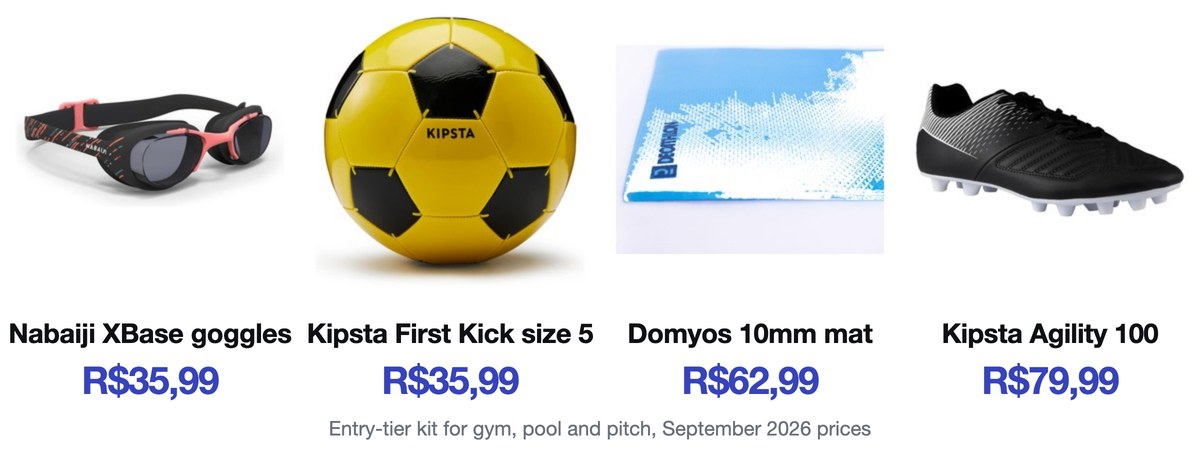
These three categories are where Decathlon is hardest to beat on price in Brazil, mostly because the products are simple and there is nothing to get wrong.
- Tapete de Treino 10mm Domyos — R$62,99. Ten millimetres is thick enough for floor work on a hard floor. If you want it for yoga rather than core work you want something thinner and grippier — a 5mm mat, or see our Liforme yoga mat review for what the other end of that market costs.
- Caneleiras de Peso 2kg Domyos — R$53,99. Ankle weights, sold in pairs. The 4kg pair is R$75,99 and the 8kg R$119,99.
- Óculos de Natação XBase Nabaiji — R$35,99. Adult goggles that seal properly. Add a fabric cap at R$15,99 and you have a complete pool kit for R$51,98.
- Bola First Kick tamanho 5 Kipsta — R$35,99. Sizes 3 and 4 are R$33,99 and R$35,99. A machine-stitched ball at this price will not survive a concrete pitch for long, but on grass it is fine.
- Chuteira Agility 100 Kipsta — R$79,99. Firm-ground boots for eighty reais. Thin, no real ankle support, entirely adequate for a weekly game.
The “was” price is noise
At the moment we pulled the catalogue, 1,388 of 1,792 own-brand listings — 77% — carried a crossed-out original price. A catalogue that is three-quarters on sale is not on sale.
The shape of the discounts gives it away. Sorting every markdown by depth, 1,112 of the 1,388 land on exactly 5%, 10% or 15%, with 605 sitting at precisely 10%. These are not per-product decisions about clearing stock. They are three levers applied across whole categories at once, and they move. There is a visible fingerprint, too: Decathlon prices own-brand goods ending in ,99, and 205 listings end in ,49 instead — 156 of which are simply a ,99 price with 15% taken off.
The practical upshot: do not wait for a sale, because you are already in one, and do not treat “R$299,99 was R$399,99” as evidence that R$299,99 is cheap. The genuinely unusual markdowns are the ones that do not fit the pattern — a 40% cut on a Btwin pannier rack, 33% off an Olaian wetsuit — and those tend to be real end-of-line clearance.
Three kits, with the real totals
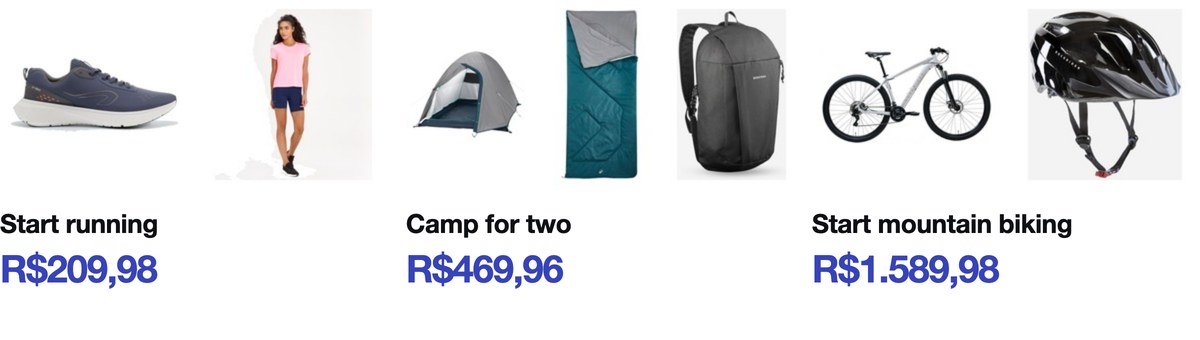
Prices as listed in September 2026. Every item is sold by Decathlon itself rather than a marketplace seller, which matters for the warranty and for whether you can exchange it.
| Kit | What is in it | Total |
|---|---|---|
| Start running | Jogflow 100.1 shoes R$169,99 + Run 100 tee R$39,99 | R$209,98 |
| Swim at the local pool | XBase goggles R$35,99 + fabric cap R$15,99 | R$51,98 |
| Train at home | 10mm mat R$62,99 + 2kg ankle weights R$53,99 | R$116,98 |
| Play football | Agility 100 boots R$79,99 + First Kick size 5 R$35,99 | R$115,98 |
| Camp for two | MH100 tent R$249,99 + two 20°C bags R$179,98 + Arpenaz 50 pack R$39,99 | R$469,96 |
| Start mountain biking | Rockrider EXPL 50 aro 29 R$1.499,99 + ST 50 helmet R$89,99 | R$1.589,98 |
Two of those baskets clear R$250, which is the threshold where paying by Pix takes another 5% off — R$23,50 on the camping kit and R$79,50 on the bike. The rules around that discount, the regional free-shipping minimums and the returns windows are their own subject, and we went through them in detail in our Decathlon Brazil review.
What not to buy here
Three things, in rough order of how much money they will cost you.
Partner brands, if you came here for a bargain. Nike, Adidas, Asics, Oakley and The North Face all sit in the Decathlon grid at ordinary retail money. Adidas Adizero Evo SL running shoes are R$1.099,99; an Adizero running tee is R$149,99 to R$249,99. Those are recommended-price figures, not Decathlon prices, and none of them carry the two-year own-brand warranty. Buying Adidas at Decathlon is fine. Just do not expect the shopfront to make it cheaper — the own-brand alternative is the discount.
Anything sold by a marketplace seller. Of the 1,799 listings we pulled, only seven were not sold by Decathlon’s own Brazilian entity — so on own-brand searches this is rare — but it gets much more common once you search across the wider catalogue. Those items lose the two-year own-brand warranty, cannot be exchanged at all, and carry a seven-day refund window instead of thirty.
The 900 tier, if you are new to the sport. It is the one genuine trap in the numbering system. A 900 is priced against real brands because it is competing with them, and if you are eight weeks into running or camping you will not notice what you paid for. Buy the 100, use it until something about it annoys you, and let the annoyance choose your upgrade.
Frequently asked questions
What do the numbers on Decathlon products mean?
They are a price and specification tier. 100 is the entry level, 500 is mid-range and 900 is the top of the line, with 300 and 700 used occasionally. The letters in front vary by sport — MH and NH for hiking, JF and KS for running, ST and EXPL for mountain bikes — but the number means the same thing throughout. Across the own-brand listings we sampled on decathlon.com.br, the median 100 was R$84,99, the median 500 R$151,99 and the median 900 R$249,99.
What is the best value product at Decathlon Brazil?
The Quechua Arpenaz 50 10-litre daypack at R$39,99 is the strongest value on the site: a usable trail daypack for the price of a couple of coffees. Close behind it are the Kiprun Run 100 technical running tee at R$39,99, the Kipsta First Kick football at R$35,99 and the Nabaiji XBase swimming goggles at R$35,99.
Are Quechua and Kiprun the same company as Decathlon?
Yes. Quechua, Kiprun, Kalenji, Forclaz, Rockrider, Btwin, Van Rysel, Domyos, Corength, Kipsta, Nabaiji, Olaian, Artengo and Simond are all Decathlon’s own brands, made and sold by Decathlon rather than licensed in. In our sample, 1,734 of 1,792 listings sold by Decathlon’s Brazilian entity were flagged as “Marcas Decathlon”. They carry a minimum two-year warranty in Brazil against the 90 days the consumer code requires.
Why do Kalenji and Kiprun both appear on running shoes?
Decathlon is renaming its running range from Kalenji to Kiprun, and the Brazilian site is mid-transition, so both names are live and occasionally appear on the same model. It does not indicate a difference in quality or tier. Go by the model number instead.
Are the star ratings on Decathlon Brazil reliable?
No. Of the 1,792 own-brand listings we pulled, 1,258 had no rating at all, and of the 534 that did, 518 showed exactly “4”. Only fifteen showed 5 and one showed 2. A value that is identical across 97% of the products carrying it cannot be used to rank anything, so use the tier number as the quality signal instead.
Is the discount on Decathlon Brazil real?
Mostly it is a standing markdown rather than a sale. At the time we sampled the catalogue, 1,388 of 1,792 own-brand listings carried a crossed-out original price, and 1,112 of those were exactly 5%, 10% or 15% off, with 605 at precisely 10%. Those are category-wide levers. Discounts that do not fit the 5/10/15 pattern — 25% and above — are more likely to be genuine end-of-line clearance.
How much is a starter kit at Decathlon Brazil?
Using September 2026 prices: swimming goggles and a cap come to R$51,98, a home training mat and ankle weights R$116,98, football boots and a ball R$115,98, running shoes and a technical tee R$209,98, a two-person camping set R$469,96, and a mountain bike with a helmet R$1.589,98. Baskets over R$250 qualify for a further 5% off when paid by Pix.
The short version
Learn the number and you have learned the shop. Buy the 100 in everything except bikes, where the EXPL 50 at R$1.499,99 is the floor worth starting from and the Explore 100 at R$1.999,99 is the upgrade that pays for itself. Treat the star ratings as decoration and the crossed-out prices as wallpaper. Check that what is in your basket is sold by Decathlon and not by somebody renting the shopfront, because that is what the two-year warranty is attached to. And if you are new to whatever you are buying kit for, spend less than you think you should — the R$39,99 daypack has no features to regret.
More shopping guides: Decathlon Brazil: prices, Pix, delivery and returns, Walmart Canada and Victoria’s Secret UK.
Sources: 1,799 live product listings read from decathlon.com.br’s own catalogue data in September 2026, covering camping and hiking, running, cycling, fitness, football, swimming, surf, racket sports and hiking footwear; of those, 1,792 were sold by Iguasport Ltda, Decathlon’s Brazilian entity, and 1,734 were flagged “Marcas Decathlon”. Prices, sellers, tier numbers, rating fields and markdown percentages are as published by the site at the time of the pull. Product photography is Decathlon’s own. Brazilian prices and promotions move constantly — the figure shown at checkout is the one that counts.