
Disclosure: This is an independent review. Some links below are affiliate links, which means we may earn a small commission if you buy through them, at no extra cost to you. It never changes our recommendations.
Most ceiling fans cost less than a weekly grocery shop. Big Ass Fans sells one for $10,699. That gap is the whole question, and the answer has almost nothing to do with the fan being pretty. It comes down to a piece of physics that hardware-store fans cannot cheat: to move a large volume of air quietly, you need diameter, not speed.
Quick answer: Big Ass Fans is a Lexington, Kentucky manufacturer of high-volume, low-speed (HVLS) fans, founded in 1999. List prices run from $849 for the residential Haiku L to $10,699 for the 24-foot Powerfoil D. The fans are worth it in rooms with high ceilings, large floor areas or covered outdoor space. In a standard 8-foot bedroom, a $150 fan does the same job.
Where the name came from
The company started in 1999 as the HVLS Fan Company, selling fans built to cool dairy cattle in California barns. The founder, Carey Smith, had one question, which the company still repeats on its about page: “Can a fan be made to revolutionize comfort for people?”
The rebrand was not a marketing exercise. Customers kept phoning and asking a version of the same thing.
“Are you the guys who make those big ass fans?” That call came often enough that the company changed its name to match and put a donkey named Fanny on the logo. “We don’t just move air, we transform experiences,” writes Big Ass Fans of what came next.
The business grew well past the joke. Carey Smith sold to private equity firm Lindsay Goldberg in 2017 in a deal widely reported at $500 million. Three and a half years later the company changed hands again: according to Lindsay Goldberg’s July 2021 announcement, it agreed to sell Big Ass Fans to Madison Industries’ indoor air quality vertical in a transaction valued at $1.1 billion. One detail from that first sale is worth keeping: the company’s stock appreciation rights programme paid out roughly $50 million across more than 100 employees.
What HVLS actually means
High-volume, low-speed describes the trade. A hardware-store fan spins a short blade fast, which produces a narrow, turbulent, noisy jet of air. An HVLS fan turns a long airfoil slowly, which pushes a wide column of air down to the floor where it spreads outward in every direction.
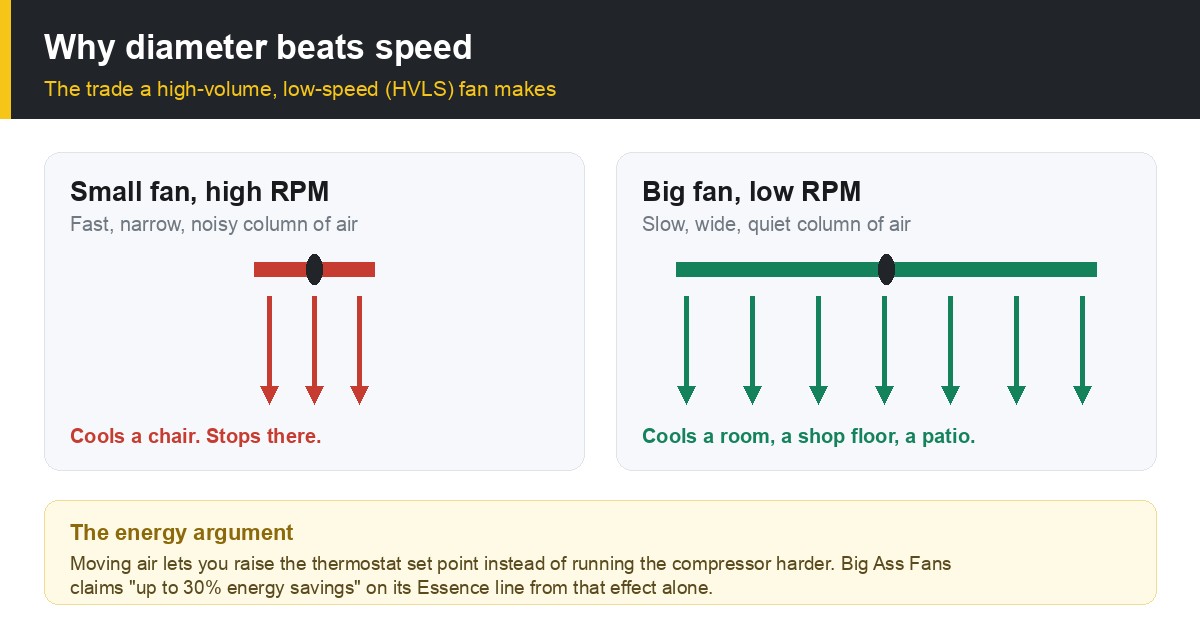
That column is why a single 24-foot fan can serve a warehouse bay that would otherwise need a dozen wall units. It also explains the energy pitch. Moving air over skin speeds up evaporation, so a room feels cooler than the thermometer says, which means you can raise the thermostat set point rather than run the compressor harder. The company claims “up to 30% energy savings” from that effect on its Essence line.
Treat that number as a ceiling, not a promise. It assumes you actually change your thermostat behaviour. A fan cools people, not rooms. Leave one running in an empty workshop and you are simply paying to stir air.
What the range costs
The catalogue splits cleanly in two. Everything up to the i6 is meant for houses. Everything from AirEye up is built for spaces where the ceiling is somewhere above a forklift.
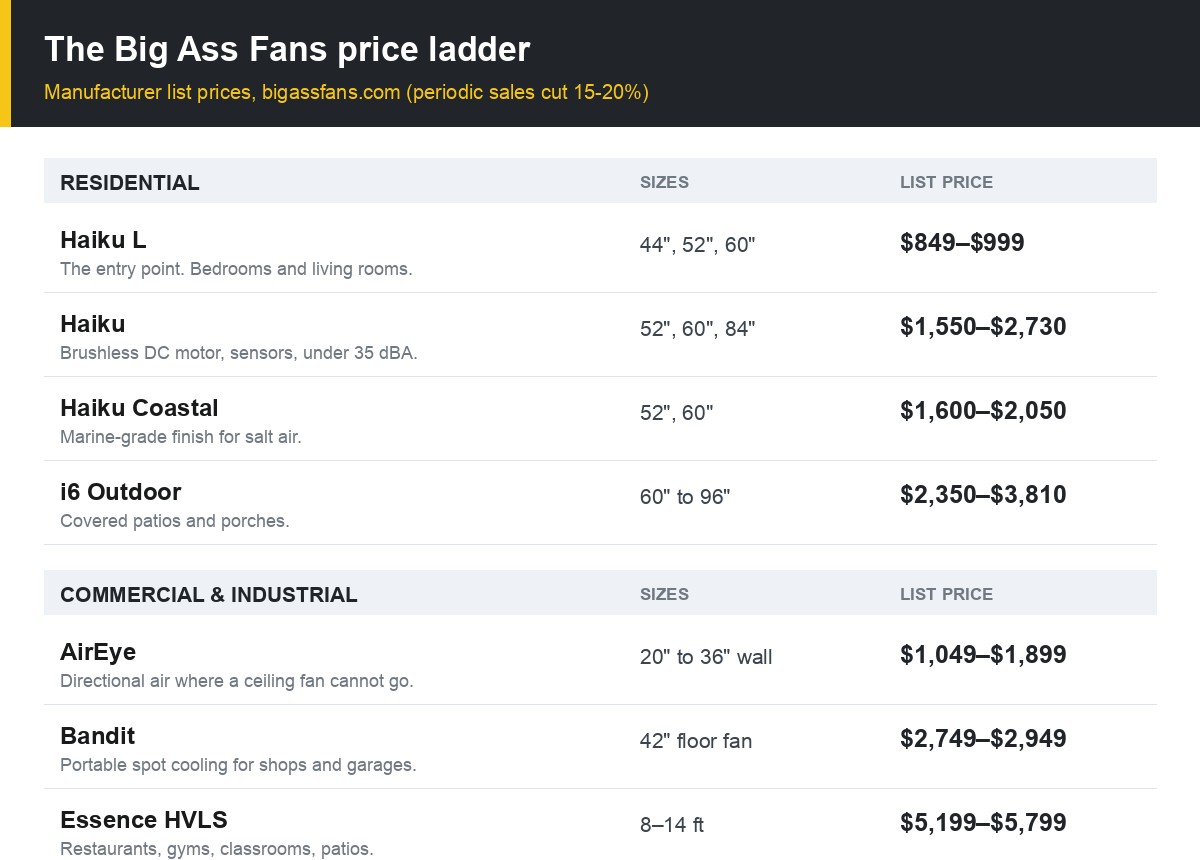
Those are list prices from bigassfans.com. The site runs sales several times a year that typically take 15% to 20% off residential lines, so the Haiku L in particular is often available for closer to $680.
The residential fans, in plain terms
The Haiku is the one that justifies the brand’s reputation. It comes in 52, 60 and 84 inch diameters with three airfoils in aluminium or Moso bamboo, and according to Big Ass Fans’ published specifications it moves up to 17,369 CFM while staying under 35 dBA at full speed and drawing as little as 2.4 watts on low. The motor is brushless DC. Every unit is balanced by hand before it ships, which is the practical reason these fans do not develop the wobble that plagues cheaper ones after a couple of summers.
Built-in temperature and occupancy sensors run the fan without you touching anything, and it talks to Apple HomeKit through Matter, Amazon Alexa, Google Home and Ecobee. The Haiku L at $849 drops the sensors and the exotic materials but keeps the shape and the quiet. The Haiku Coastal adds a marine-grade finish for houses near salt air, and the i6 is the outdoor model, sized 60 to 96 inches for covered patios.
The commercial fans
The Essence is the crossover, sold in 8 to 14 foot diameters for restaurants, classrooms, gyms and large covered patios, with a direct-drive motor that runs “quietly enough for restaurants, libraries, classrooms, and living rooms alike,” says Big Ass Fans. The Powerfoil D is the industrial one, 8 to 24 feet, IP66-rated for dust and water, under 40 dBA, with a permanent magnet direct-drive motor that removes the gearbox that made older industrial fans whine. It mounts to I-beam, bar joist or Z-purlin structures, with double safety cables and Grade 8 hardware.
Two smaller commercial products fill the gaps. AirEye is a wall-mounted fan from $1,049 for spots where nothing can hang from the ceiling, and Bandit is a 42-inch floor fan at $2,749 for shops and garages that need air moved somewhere different each week.
Why it costs what it costs
Three things are being paid for, and only one of them is the metal.
- Engineering that is genuinely protected. The company’s patent page lists over 100 US utility and design patents covering airfoil profiles, restraint systems, controls and sensor behaviour. Airfoil shape is not decoration on a fan this size. It sets how far the air column travels before it breaks up.
- Failure consequences. A 24-foot fan turning above a packing line is a safety system as much as a comfort one, which is where the double safety cables and Grade 8 hardware come from.
- Support that answers. The company sells direct, staffs US-based support rather than a call centre, and publishes warranty documents per product family.
What you are not paying for is exotic cooling capability. No fan lowers air temperature. If your workshop hits 40°C, an HVLS fan makes it bearable to work in. It does not make it cool.
Who should buy one, and who should not
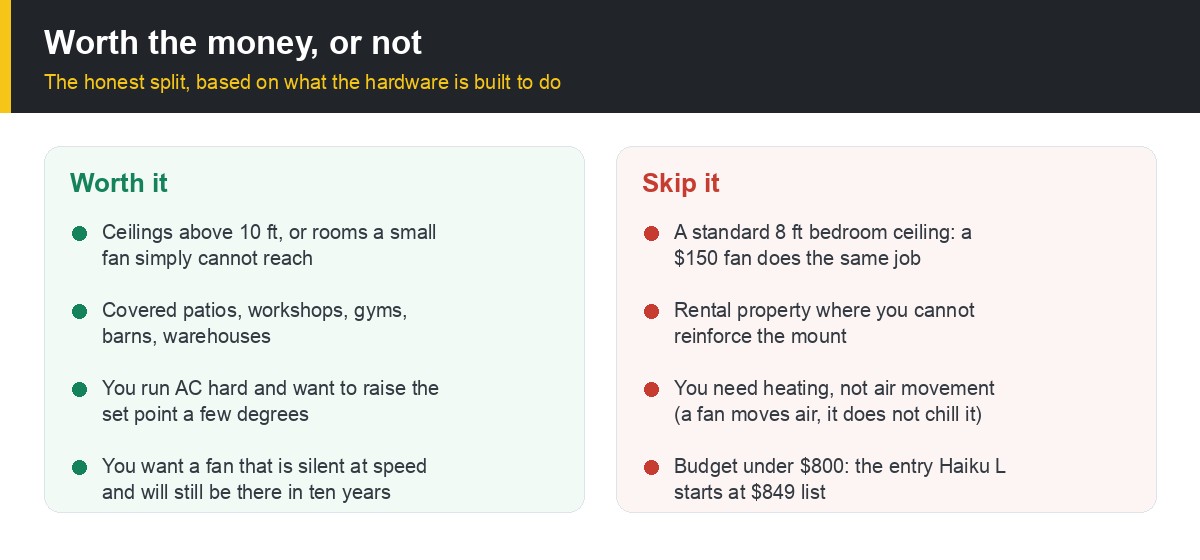
The clearest buying signal is ceiling height. Above about 10 feet, a standard 52-inch fan stops delivering usable airflow to the floor and starts being decorative. Large open rooms, double-height living spaces, covered patios, workshops, gyms and barns are where the money makes sense.
The clearest reason to skip is a normal bedroom with a normal ceiling. A well-made $150 fan moves enough air across a 12 by 12 foot room, and the Haiku’s advantages, which are silence, sensor automation and the absence of wobble, are real but not $1,400 of real for most people. Renters have a second problem: these fans are heavy, and mounting a large one properly can mean reinforcing the joist.
Getting the size right
Ceiling height decides mounting hardware, and floor area decides diameter. As rough guidance from the residential range: a 52-inch fan suits rooms up to roughly 200 square feet, 60 inches covers a larger living space, and the 84-inch Haiku or a 96-inch i6 is for a great room or a wide patio. Commercial sizing is a different exercise, and the company publishes clearance guidelines per product because the fan needs specified space above the airfoils as well as below them.
One rule saves most of the mistakes: measure the distance from the airfoils to the floor before you choose a diameter, not after. If your ceiling is 9 feet, the fan you want is smaller than the one you were about to order.
Frequently asked questions
What does HVLS mean?
HVLS stands for high-volume, low-speed. It describes a fan with a long airfoil that turns slowly, moving a wide column of air quietly instead of a narrow, fast jet. Big Ass Fans built its business on the format in 1999, starting with fans designed to cool dairy cattle before applying the same principle to warehouses and homes.
How much do Big Ass Fans cost?
List prices start at $849 for the 44-inch Haiku L and run to $10,699 for a 24-foot Powerfoil D. In between sit the Haiku at $1,550 to $2,730, the outdoor i6 at $2,350 to $3,810, and the commercial Essence at $5,199 to $5,799. Periodic sales cut residential prices by roughly 15% to 20%.
Are Big Ass Fans worth the money?
In rooms with ceilings above 10 feet, large floor areas or covered outdoor space, yes. The airflow reaches the floor, the fan stays under 35 dBA, and it lets you raise the thermostat set point. In a standard bedroom with an 8-foot ceiling, a $150 fan delivers comparable comfort and the premium is hard to justify.
Who owns Big Ass Fans?
Madison Industries owns Big Ass Fans. Founder Carey Smith sold the company to private equity firm Lindsay Goldberg in 2017 in a deal reported at $500 million, and Lindsay Goldberg agreed to sell it to Madison Industries’ indoor air quality vertical in July 2021 in a transaction valued at $1.1 billion. Headquarters remain in Lexington, Kentucky.
How quiet is a Haiku ceiling fan?
The manufacturer specifies the Haiku at under 35 dBA at maximum speed, which is quieter than a typical refrigerator hum, and it draws as little as 2.4 watts on its lowest setting. The brushless DC motor and hand-balancing before shipment are what keep it quiet and free of wobble.
What size fan do I need for my ceiling?
Match diameter to floor area and check clearance first. A 52-inch fan suits rooms up to about 200 square feet, 60 inches fits a larger living room, and 84 to 96 inches is for great rooms and wide patios. The company publishes clearance guidelines per model, since each fan needs specified space above and below the airfoils.
The verdict
Big Ass Fans sells a category, not a luxury version of a commodity. If your problem is a tall room, a wide shop floor or a patio that becomes unusable in July, nothing at hardware-store prices solves it, and the Haiku or Essence is money spent on a real fix. If your problem is a warm bedroom, buy the $150 fan and spend the difference elsewhere.
The same test applies to any premium product, which is how we approached the Liforme yoga mat and the homeware ranges in our Online Home Shop review: work out what the cheap version fails at, then decide whether that failure costs you anything.
Sources: product specifications, pricing and clearance guidance from bigassfans.com (Haiku, Haiku L, i6, Essence, Powerfoil D and AirEye product pages, plus the company patent listing); ownership history from Lindsay Goldberg’s 2021 sale announcement. Prices are manufacturer list prices at the time of writing and change with periodic sales. Confirm current pricing, sizing and warranty terms on the official site before ordering.