Disclosure: This is an independent guide. Some links below are affiliate links, which means we may earn a small commission if you buy through them, at no extra cost to you. It never changes what we recommend.
Open almost any course on Udemy and you’ll get the same little routine: a crossed-out list price, a much smaller sale price, and a line in red telling you there’s one day left at this price. Come back a couple of weeks later and there’s a good chance you’ll find a fresh countdown.
None of that makes Udemy a bad place to learn. A handful of its courses have taught more people than most universities, and for practical skills like Python, Excel or AWS exam prep it’s hard to beat on value. But Udemy rewards people who know how it works. When should you buy? Is the subscription worth it? What does the refund policy actually cover, and how do you tell a course that’s kept up to date from one living off reviews it earned years ago? That’s what this guide covers.
Quick answer: Udemy is an online course marketplace with more than 250,000 courses, most of them practical: programming, IT certifications, Excel, design, marketing. Anyone can publish a course, so quality runs from excellent to awful. List prices sit between $19.99 and $199.99, but courses are on sale so often that in the US you’ll usually pay somewhere around $10 to $20, and you keep access for life. The alternative is Personal Plan, a subscription to a curated set of about 26,000 top-rated courses. Courses you buy come with a 30-day refund window (with some exceptions); subscriptions generally can’t be refunded. Since May 2026 Udemy has been owned by Coursera, but the two still run as separate sites with separate accounts.
What Udemy actually is in 2026
Udemy is a marketplace, not a school. Instructors make the courses, upload them and earn a share of each sale; Udemy hosts them, markets them and, for a lot of courses, decides what price you’ll actually pay. Nobody at Udemy checks that a course on machine learning is any good before it goes live. Reviews and ratings do that job after the fact.
That’s the main thing to understand about the platform. Next to a 50-hour bootcamp with half a million ratings, you’ll find a three-hour course thrown together last month, and both get the same polished course page.
The ownership news this year is worth knowing about, though it doesn’t change much yet. Coursera completed its merger with Udemy on May 11, 2026, and Udemy is now a Coursera subsidiary. For learners, the two are still separate: different websites, different accounts, different subscriptions. A Udemy subscription doesn’t get you into Coursera’s courses, and vice versa. If that changes, it’ll be a big deal for pricing, so it’s one to watch.
One more thing before you spend anything: if your employer gives you access to Udemy Business, check it first. It’s the company version, with its own curated library, and plenty of the best-known courses are in it. No point paying for something you already have through work.
What a Udemy course really costs
Every paid course has a list price somewhere between $19.99 and $199.99. On paper, the instructor picks it. In practice, instructors can opt into the Udemy Deals Program, which lets Udemy set the price it actually charges, and the instructor’s chosen price becomes a fallback for when Udemy isn’t adjusting it. That’s why the same course can cost $89.99 one day and $14.99 the next.
Sales are the normal state of things, not the exception. Site-wide promotions with “courses from” pricing in the low teens come around regularly, and new accounts often get their own introductory offer. Prices are also set by country, so a friend overseas may see a different number for the same course.
My rule is simple: if a course is showing anything close to its list price, don’t buy it today. Add it to your wishlist and wait for the next sale, which is rarely far off. Paying more than about $20 for a single course only makes sense for niche topics that never seem to get discounted. If you’ve ever wondered how much a “was” price really means, our guide to judging online sale prices covers the general problem; on Udemy, the honest answer is “almost nothing.”
Personal Plan or buy courses one at a time?
Udemy really wants you on the subscription. On many course pages the Personal Plan offer now sits above the one-off price, so read the page before you click the big purple button. Here’s how the two compare:
| Buying a course | Personal Plan | |
|---|---|---|
| What you get | That one course, from a catalog of 250,000+ | About 26,000 curated top-rated courses, plus coding exercises, exam practice tests and Udemy’s AI Assistant |
| Price | List $19.99–$199.99; usually around $10–$20 on sale in the US | Advertised from about $13 a month in the US (the cheapest way to pay; monthly billing costs more) |
| Access | Lifetime | Only while you’re subscribed |
| Refunds | 30 days, with conditions | None, unless local law says otherwise; free trials can be cancelled before you’re charged |
| Best for | You know exactly which one or two courses you want | You’ll work through several courses, or you’re prepping for a certification |
The math is easier than it looks. If the course you want is $15 on sale, the subscription only wins if you’d otherwise buy more than one course a month and actually take them. Most people don’t. They buy one course, do a third of it, and get busy. For them, the cheap one-off purchase is better, because it’s still there in two years when they want to look something up. A Personal Plan course disappears the day you cancel.
Where the plan does make sense is a focused stretch of study. Say you’re preparing for an AWS or CompTIA exam over three months: you’ll probably want a main course, a second instructor’s take on the hard topics, and a few sets of practice tests. That’s four or five purchases, and the subscription covers them all. Udemy prices the plan by country too, so check the checkout screen rather than trusting the “starting at” figure, and set a reminder before any free trial ends.
It’s the same question as any subscription, really, and our Paramount+ review works through it the same way: count what you’ll actually use, not what you could use.
The refund policy, read properly
“30-day money-back guarantee” is what most people remember. The actual policy, on Udemy’s help site, is more conditional than that, and it’s worth two minutes before you buy:
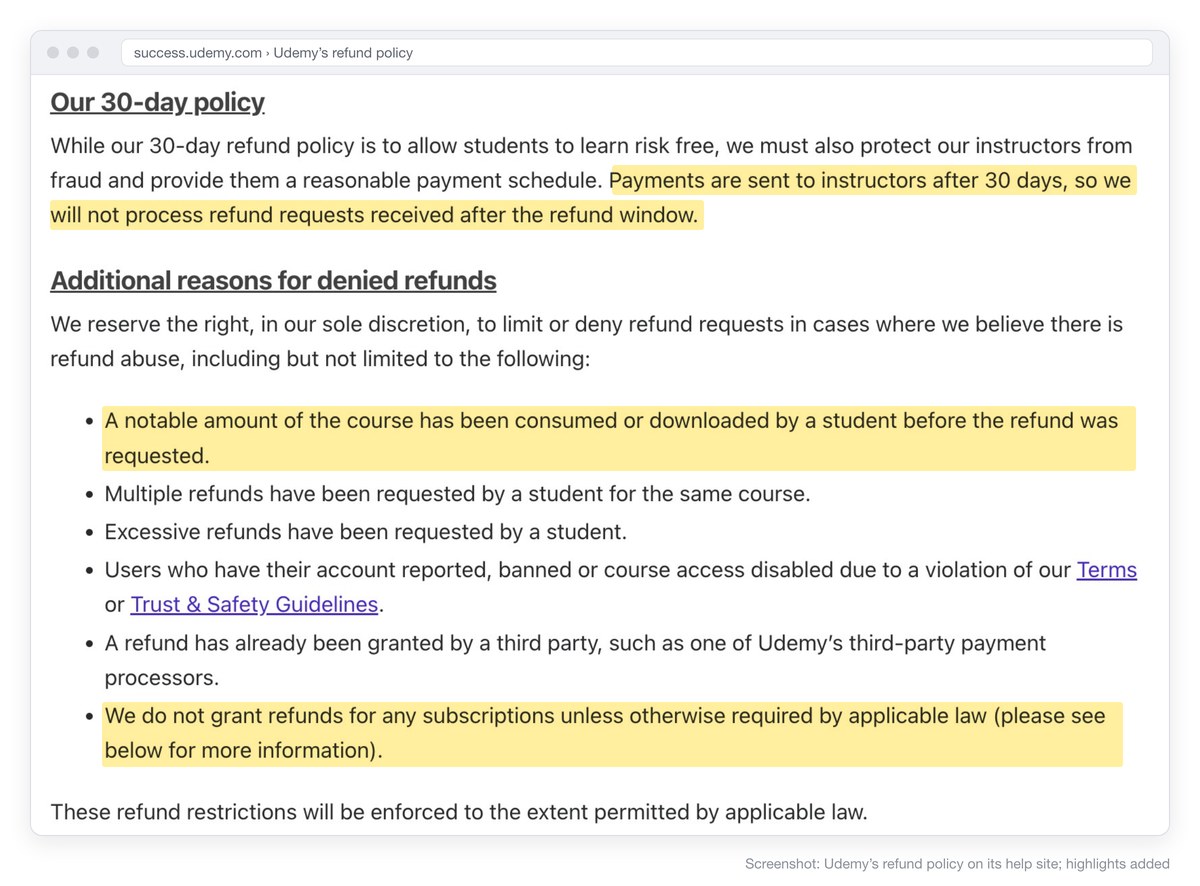
The 30 days aren’t arbitrary. Udemy pays instructors after 30 days, so once that window closes, the money’s gone and no request will be processed. Inside the window, Udemy can still refuse a refund if it thinks you’re abusing the system. The reasons it lists include having consumed or downloaded “a notable amount” of the course, asking for a refund on the same course more than once, or simply requesting too many refunds overall. “Notable amount” isn’t defined anywhere, which is the point: don’t finish half a course and then decide you didn’t like it.
A few other details catch people out:
- App Store purchases only get credit. If you buy a course in the iPhone app, Apple processes the payment, and Udemy will only refund you in Udemy credits, not cash. The same applies to some bank transfer and cash payment methods. Buy on the website if you want your money back as money.
- You can’t request a refund in the app. It has to be done in a browser, from your purchase history or from the course player’s menu.
- Subscriptions are different. Personal Plan has no 30-day guarantee and no partial refunds, except where local consumer law requires one. If you started on a free trial, you can cancel before it converts and you won’t be charged.
- Credits are the faster option. If you choose Udemy credits instead of a refund to your card, they land in your account straight away. Fine if you were going to buy another course anyway.
The practical approach: watch the first hour or so, try one of the exercises, check that the audio and pace work for you, and make the call within a few days. That keeps you well clear of the “notable amount” line.
How to check a course in five minutes
Ratings on Udemy are useful, but they’re slow to move. A course can coast on reviews it earned years ago. Here’s what I look at on a course page, using one of the platform’s biggest Python courses as the example:
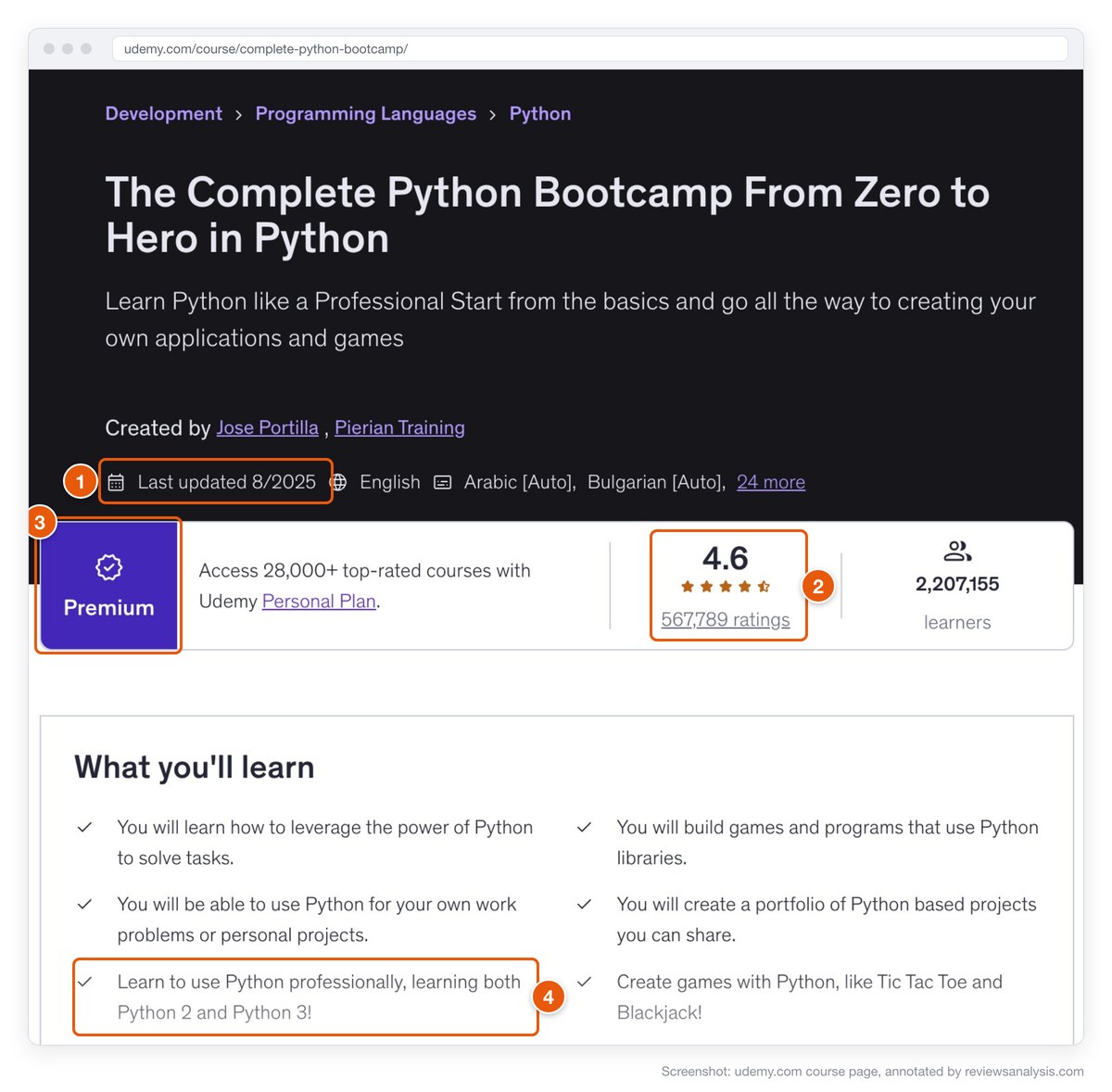
- Last updated. This bootcamp has more than 2 million learners and was last updated in August 2025. For core Python, a year without changes is fine. For anything tied to a fast-moving tool (cloud platforms, AI, front-end frameworks, certification exams that get revised), it’s a warning sign.
- The number of ratings, not just the stars. A 4.6 from over half a million people means a lot more than a 4.9 from 40.
- The Premium badge. This means the course is included in Personal Plan. No badge, and you can only buy it outright.
- What the course promises. This one still says you’ll learn “both Python 2 and Python 3.” Python 2 reached end of life on January 1, 2020. That doesn’t make the course useless, but it does tell you the sales page hasn’t been rewritten in years, so check the curriculum and recent reviews before assuming everything else is current.
Three more checks that aren’t in the screenshot:
Compare the hours with the curriculum. Sales copy ages faster than the course itself. The description of Angela Yu’s 100 Days of Code bootcamp says it includes “over 65 hours of HD video tutorials”; when I looked, the course content section listed 102 sections, 604 lectures and 56 hours 48 minutes in total, and that total includes reading and exercises. It’s still a huge course, and very well reviewed. It’s just not quite the number on the tin.
Watch two preview lectures at normal speed. Not the polished intro video, an actual lesson. You’re checking the audio, the pace and whether you can follow the instructor for 40 hours.
Read the recent reviews, especially the 3-star ones. Sort by most recent. Five-star reviews say “great course!”; three-star reviews tell you the section on deployment is broken since the last update, or that questions in the Q&A go unanswered. That last one matters more than people expect, because when you get stuck on a long technical course, the Q&A is your only lifeline.
And don’t read too much into the “Bestseller” badge. It’s a sales signal. It tells you lots of people bought the course, not that it’s right for you.
Where Udemy is genuinely good
Udemy is at its best where the skill is practical, the outcome is clear, and a good instructor with years of student questions behind them beats a fancier platform. These four are good examples of what that looks like:

Programming taught through projects, Excel, and certification prep are the standouts. Courses like these have been refined by hundreds of thousands of students running into the same problems, and at sale prices they cost less than a single textbook.
Certification prep deserves its own note. Udemy is a cheap way to prepare for an exam, but the exam isn’t included. The AWS Certified Solutions Architect Associate exam, for example, costs $150 on its own, booked through AWS. A $15 course and a set of practice tests are a sensible spend next to that, but budget for both.
Udemy is weaker where you need someone to look at your work. Writing, design, anything with a portfolio review or graded assignments: a pre-recorded course can’t tell you what’s wrong with your draft. It’s also weak on soft skills, where some courses are an hour of good advice stretched into six. If you’re learning marketing, for instance, a course will teach you the tools, but you’ll learn more from running a small, real campaign; our first TikTok Ads campaign guide is one way to start.
Are Udemy certificates worth anything?
Paid courses give you a certificate of completion when you finish. Free courses don’t. Udemy is clear that it isn’t an accredited institution, so the certificate won’t count as college credit or as a formal qualification.
That doesn’t make it worthless, just limited. It’s a reasonable line on LinkedIn and shows you’re learning, but what gets attention in a job application is what you can show: the project you built, the dashboard you made, the exam you passed. In IT especially, employers care about the vendor certification (AWS, CompTIA, Microsoft), not the Udemy course you used to prepare for it.
Who should use Udemy, and who shouldn’t
Udemy suits you if you’re reasonably self-directed, you want a specific practical skill, and you’d rather pay $15 than $500 to learn it. It’s especially good if you like to own your learning material and come back to it later.
It’s a worse fit if you need deadlines and someone checking in on you to finish anything, if you need a recognized credential, or if you want feedback on your work. There’s no cohort and no tutor, and nobody notices if you stop at lecture 30. That’s the trade-off behind the low prices.
Frequently asked questions
Is Udemy legit?
Yes. Udemy has been running since 2010, and since May 2026 it has been owned by Coursera. The platform itself is legitimate; the thing to watch is course quality, because anyone can publish. Check the last-updated date, the number of ratings and recent reviews before you buy.
Why are Udemy courses always on sale?
Instructors can opt into the Udemy Deals Program, which lets Udemy set the price it charges. The list price is mostly a reference point. In the US, courses usually sell for around $10 to $20 during the platform’s frequent sales.
Can I get a refund on Udemy?
Courses bought on the Udemy website can be refunded within 30 days, but Udemy can refuse if you’ve consumed or downloaded a notable amount of the course or have requested many refunds. iPhone app purchases are refunded in Udemy credits only, and subscriptions aren’t refundable unless local law requires it.
Is Udemy Personal Plan worth it?
Only if you’ll take more than about one course a month, or you’re preparing for a certification and want several courses and practice tests. If you just want one or two courses, buying them on sale is cheaper and you keep them for life.
Are Udemy certificates recognized by employers?
They’re not accredited, so they don’t count as formal qualifications or college credit. They can support your LinkedIn profile, but employers care more about projects you can show and vendor certifications like AWS or CompTIA.
Is Udemy part of Coursera now?
Yes. Coursera completed its merger with Udemy on May 11, 2026. The two platforms still run separately, with separate accounts and subscriptions, so a Udemy subscription doesn’t include Coursera courses.
The short version
Udemy is one of the cheapest ways to learn a practical skill online, as long as you never pay list price and you pick courses carefully. Wait for a sale, buy on the website rather than in the iPhone app, check when the course was last updated and read the recent 3-star reviews. Make your refund decision in the first few days. And only subscribe to Personal Plan if you’ve got a concrete plan to get through several courses.
Sources: Udemy’s help center articles “Udemy’s refund policy” and “How to refund a course”; the Udemy Personal Plan page and Plans & Pricing page; Udemy’s instructor help on course pricing and the Udemy Deals Program; Udemy Business’s certificates of completion FAQ; Udemy’s announcement of the completed Coursera merger (May 11, 2026); and the udemy.com course pages for 100 Days of Code, The Complete Web Development Bootcamp, The Complete Python Bootcamp From Zero to Hero, Microsoft Excel from Beginner to Advanced and Ultimate AWS Certified Solutions Architect Associate. Prices, course statistics and policies were recorded at the time of writing and change often; the price at checkout is the one that counts.