Disclosure: This is an independent guide. Some links below are affiliate links, which means we may earn a small commission if you buy through them, at no extra cost to you. It never changes our recommendations.
“Is SHEIN safe” is really three different questions wearing one coat. Is it safe to put my card in. Is it safe to give them my data. Is the stuff they send me safe to wear. They have different answers, and the honest ones are not all the same.
We covered whether the company is legitimate in a separate piece. This one is about risk, specifically.
Quick answer: Paying is low risk if you use a credit card or PayPal on the official app or shein.com — the real payment danger is fake SHEIN sites and fake support phone numbers, not SHEIN’s checkout. Data collection is extensive and the company has a poor track record here, including a 2022 settlement over a breach it had understated. Product safety is the genuinely mixed one: independent testing keeps finding chemical limit breaches in specific categories, particularly children’s items, footwear and coated goods.
Payment: the checkout is not the risk
SHEIN processes a very large volume of card transactions through standard payment infrastructure, and the practical evidence from millions of orders is that entering a card at its checkout is about as risky as any other large retailer. That is not a compliment or an insult, just the baseline.
The sensible precautions are the generic ones and they matter more than the platform:
- Use a credit card or PayPal rather than a debit card. It is not about SHEIN — it is that a chargeback on a credit line is an argument about money you have not yet paid, while a debit dispute is an argument about money already gone from your account.
- Do not save the card if you order twice a year. Convenience has a cost proportional to how long the details sit there.
- Turn on two-factor authentication on the account. Account takeover, not card theft, is the more common failure in retail apps, because a compromised account has a saved address and a saved card in it.
Where the real danger sits is off-platform. Fake SHEIN storefronts with near-miss domain names are a persistent problem, and so are the “SHEIN customer service” phone numbers that dominate forum spam and some search results. SHEIN has no general phone support. Anyone answering that number is fishing for an order number and a card.
Data: extensive collection and a bad precedent
This is where the honest answer is less comfortable.
A shopping app of this type collects a great deal: browsing and interaction data, device identifiers, purchase and returns history, and the behavioural signal that drives the recommendation engine. That is the product, in a fairly literal sense — the small-batch model depends on knowing very quickly what is being looked at, not just what is being bought.
The precedent that matters: in 2022 SHEIN’s parent company settled with the New York Attorney General over a data breach affecting millions of accounts, with findings that the scale had been understated and that security practices had been inadequate. A settlement is not a criminal finding, and the incident predates a lot of corporate change. But it is the concrete data point available, and it argues for a specific habit rather than a vague unease.
The habit: use a unique password, do not reuse one from your email or banking, and enable two-factor. If a breach of a shopping account only costs you that account, it is an inconvenience. If it shares a password with something important, it is a different event entirely.
Products: the part that deserves actual caution
Here the evidence is not anecdotal, and it is worth stating plainly.
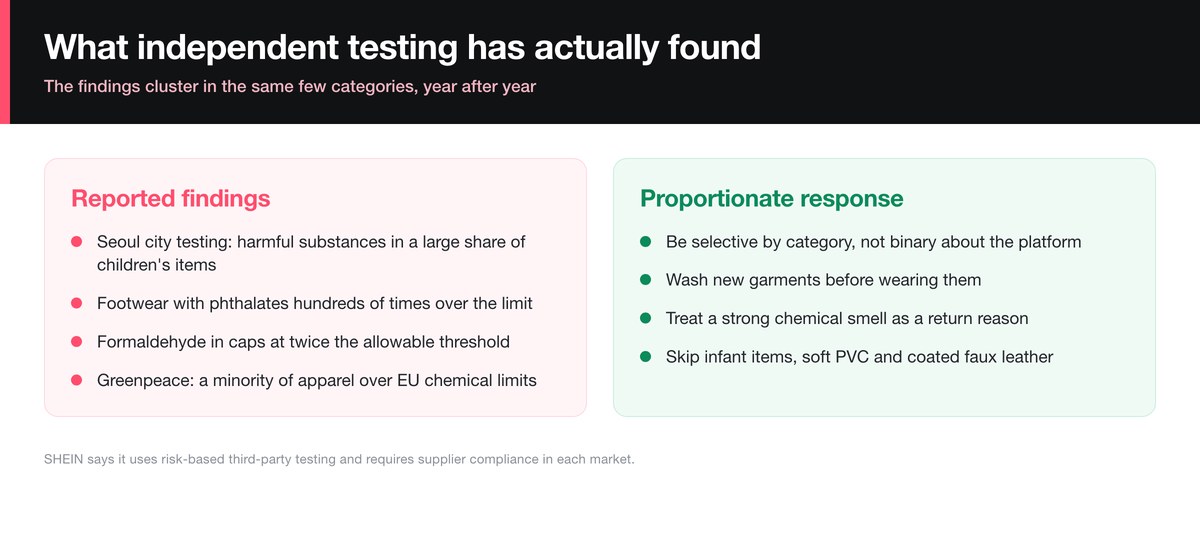
Seoul’s municipal government has run repeated laboratory testing on goods bought from cross-border platforms including SHEIN. Across seven rounds covering 93 products, harmful substances were reported in a substantial share. Individual results included children’s shoes with phthalates measured at hundreds of times the permitted level, handbags at well over a hundred times, formaldehyde in caps at twice the allowable threshold, and nail polishes exceeding limits for dioxane and methanol. A Seoul official described the underlying problem as a safety blind spot: direct-purchase imports arrive without the separate inspection a domestically distributed product would face.
Greenpeace testing of apparel samples found a minority exceeding EU chemical limits for substances including phthalates, formaldehyde and lead. A CBC Marketplace investigation in Canada commissioned lab testing on children’s clothing and accessories from several cross-border retailers and found items above Health Canada’s lead threshold.
SHEIN’s response has been consistent: it works with international third-party testing agencies on risk-based sampling, requires suppliers to comply with its internal standards and with product safety law in each market, and takes action against suppliers where non-compliance is verified. The EU added SHEIN to the tier of platforms subject to stricter obligations under the Digital Services Act in 2024, which brings product-safety enforcement under formal supervision rather than voluntary reporting.
What to do with all that, as a shopper rather than a regulator:
- Be selective by category rather than binary about the platform. The failures cluster in children’s goods, footwear, faux leather and soft plastics.
- Wash new garments before wearing. Standard advice for any imported clothing, more so here.
- Treat a strong chemical smell as a return reason, not a break-in period.
- Skip the categories where a failure would matter most — infant clothing, teething-age toys, anything a child will put in their mouth.
The pricing claims, which are their own kind of unsafe
Not a physical risk, but worth filing here because it affects what you pay.
France’s competition and fraud authority fined SHEIN 40 million euros in 2025 over misleading discount claims, after finding non-compliance across the large majority of the promotions it examined — including items where the “discounted” price was higher than the previous one. Our saving money guide goes through the implications, but the headline is simple: the struck-through number carries no information, and any decision you make should be based on the price you would actually pay today.
A short, honest risk summary
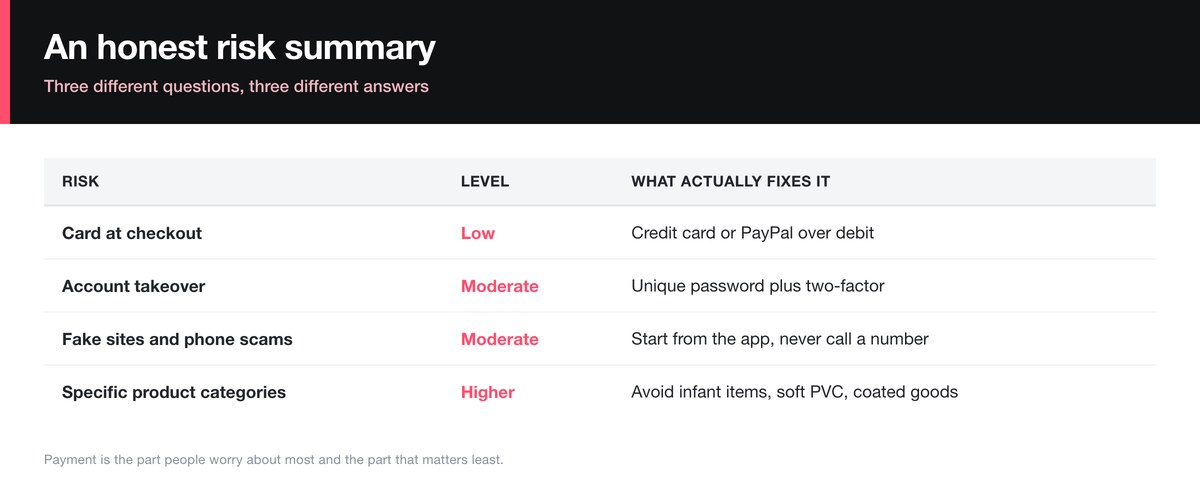
Low risk: paying with a credit card on the official app. Ordering adult clothing in mainstream categories. Returning things.
Moderate risk: the data you hand over, mitigated almost entirely by a unique password and two-factor authentication. Fake sites and fake support numbers, mitigated by only ever starting from the app or by typing the domain yourself.
Higher risk, and the one that should change your behaviour: specific product categories where independent testing keeps finding problems. That is not a reason to avoid the platform. It is a reason to be deliberate about four or five aisles of it.
Frequently asked questions
Is it safe to use a credit card on SHEIN?
Generally yes. SHEIN uses standard payment infrastructure and processes an enormous transaction volume without systemic card-fraud problems. A credit card or PayPal is preferable to a debit card because disputes are easier, and two-factor authentication on the account matters more than the payment method, since account takeover is the more common failure mode.
Has SHEIN had a data breach?
Yes. In 2022 its parent company settled with the New York Attorney General over a breach affecting millions of accounts, with findings that the scale had been understated and security practices were inadequate. The practical response is a unique password not reused anywhere else, plus two-factor authentication.
Are SHEIN clothes safe to wear?
For most adult clothing, yes, with the usual advice to wash before wearing. Independent testing by Seoul’s city government, Greenpeace and CBC Marketplace has repeatedly found chemical limit breaches concentrated in children’s products, footwear, faux leather and soft plastics. SHEIN says it runs risk-based third-party testing and requires supplier compliance.
Does SHEIN have a customer service phone number?
No general phone line. Support is handled by chat and tickets inside the official app and on shein.com. Phone numbers circulating in forum posts and search results claiming to be SHEIN support are typically scams collecting order and payment details.
How do I avoid fake SHEIN websites?
Start from the official app, or type the domain yourself rather than following an ad or a link from a message. Fake storefronts use near-miss domain names and copy the real design closely. If a site asks for payment by bank transfer or gift card, it is not SHEIN.
The short version
Credit card, unique password, two-factor, official app only. Wash things before you wear them. Buy adult clothing freely and be deliberate about children’s items, shoes and anything coated. And ignore the struck-through price entirely, which is the one piece of advice on this page that will save you actual money.
More in this series: quality by category, returns and refunds, missing parcels, and saving money.
Sources: New York Attorney General settlement with SHEIN’s parent company over a 2018 data breach, announced 2022; Seoul Metropolitan Government product safety testing rounds, 2024; Greenpeace chemical testing of fast-fashion apparel; CBC Marketplace lab testing of children’s clothing from cross-border retailers; European Commission designation of SHEIN under the Digital Services Act, 2024; DGCCRF enforcement findings and the 40 million euro fine reported in 2025; SHEIN published statements on supplier testing and compliance. Checked September 2026.